

Best Charging Hose Options for Safe and Efficient Refrigerant Refills
2026-11-18
Most refrigerant refill headaches trace back to one component nobody talks about: the charging hose. It kinks under pressure, seeps at the fitting, or leaves you guessing during a recovery. The right hose won’t just hold up—it makes each refill faster and safer. Below, we compare the options that actually earn their place in the van, including HONGSEN models that hold their own on tough jobs.
Why Cheap Hose Walls Collapse Under Vacuum
Most inexpensive hoses are built around a simple extruded tube, sometimes with a light braid or a single spiral of wire. That construction handles positive pressure well enough because the fluid pushes outward and the wall stays in tension. Vacuum flips the load: atmospheric pressure squeezes the outside, placing the wall in compression. Thin walls with little radial stiffness start to ovalize at a surprisingly low negative pressure, and once the cross-section loses its round shape, collapse follows quickly.
The weak point is usually the absence of a rigid internal or external helix. A proper vacuum hose uses a thick wall, a close-pitch wire spiral, or both to resist the crushing force. In cheaper versions, the reinforcement is spaced too far apart or is only a flat polyester yarn that adds tensile strength but almost no hoop stiffness. As vacuum increases, the unsupported sections between reinforcements buckle inward, creating flat spots that restrict flow and can tear after repeated cycling.
Temperature makes the problem worse. Soft PVC and polyurethane lose stiffness when warm, so a hose that holds its shape in a cool workshop may fold shut when transferring warm liquid under suction. Hard bends and tight clamping points also invite collapse because they concentrate the compressive stress in an already distorted section.
Fittings That Seal Tight Without Overtightening
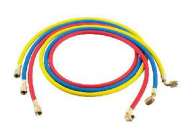
Most leaks aren't caused by a fitting that's too loose—they come from one that's been cranked past its limit. The sweet spot is a seal that engages fully while the threads still have room to breathe. Once you feel the resistance shift from smooth to firm, stop. That transition point is the fitting telling you it's already doing its job.
The real trick is matching the sealing method to the job. Tapered threads need a bit of tape or compound to fill the spiral gaps, but only two or three wraps—anything more just gets pushed out of the way. Parallel threads with an O-ring or bonded washer seal on the face, not the thread flank, so you can run them finger-tight plus a quarter turn and walk away. No need to lean on the wrench.
If you find yourself reaching for a longer handle every time, something else is wrong: mismatched materials, a damaged seat, or a fitting already distorted from the last over-tightening. A properly designed joint should hold pressure with modest torque. When in doubt, back off half a turn and watch—if it seeps, replace the seal. If it stays dry, you just proved the point.
Short Runs Versus Long Runs for Different Refrigerant Jobs
A short refrigerant run, say under twenty-five feet, rarely causes much trouble. The compressor sees roughly the pressure drop the manufacturer assumed, oil gets back without special piping tricks, and the factory charge often covers the added line volume. The real headaches show up when a condensing unit ends up on a roof and the evaporator sits two floors below, or when a mini-split line set has to snake through a finished basement for sixty feet. At that point, pressure loss stops being a rounding error and starts taking capacity out of the system.
Long runs force decisions that short runs let you ignore. Suction lines need to be sized for velocity at minimum load so oil doesn't pool in low spots. Liquid lines may need a sight glass and a little extra subcooling to keep the refrigerant from flashing before the metering device. On split systems with long vertical risers, an inverted trap at the top of the riser and a crankcase heater become cheap insurance, especially in colder climates where refrigerant likes to migrate toward the compressor during off cycles.
Different jobs have different tolerance for distance. A small reach-in cooler with a self-contained design avoids the question entirely, while a walk-in freezer with a remote condensing unit often has published limits that are more about oil return than pressure drop. Air conditioning line sets can tolerate moderate lengths if the suction line is upsized and the charge is weighed in, but a VRF system cares about total connected length plus elevation differences between branches. The job dictates whether a long run is just an inconvenience or a design problem that needs a real piping calculation.
Internal Liners Built for Modern Blends and Oils
Today's fuel formulations pack a more aggressive chemical punch than ever before. Ethanol, biodiesel, and advanced additive packages can quietly attack ordinary rubber and plastic components, causing premature softening, swelling, or hairline cracks. Our internal liners are developed specifically to shrug off these modern blends, giving each hose a durable inner barrier that keeps fuel flowing cleanly while preserving flexibility through constant temperature swings.
Rather than relying on a single catch-all material, we match the liner compound to the intended use. High-aromatic gasoline, high-ethanol mixes, and even aggressive oil blends each meet a liner formulated for that exact environment. The result is noticeably better resistance to permeation and chemical breakdown, which means fewer vapor leaks, less odor, and a longer service life in real-world equipment.
Installers often tell us the difference shows up months later, when hoses are still firm but supple instead of stiff or gummy. That kind of reliability comes from treating the inner liner as the heart of the hose, not an afterthought. Whether you are running late-model fuel injection, small engine blends, or oil transfer lines, these liners hold up without demanding constant inspection or early replacement.
Features That Prevent Accidental Venting During Disconnects
Accidental venting almost always comes down to a poppet lifting before the coupling has fully locked. In a well-designed disconnect, the poppet is held against its seat by a spring that does not release until the locking collar travels past a detent. That extra few millimetres of sleeve movement creates a hard stop between the sealed position and the open position, so there is no halfway point where fluid can sneak past the seal and spray sideways.
Some fittings go further by splitting the disconnect into two pressure events. The first motion closes the downstream valve and traps the line pressure, while the second motion releases the coupling. A small bleed channel opens only after both sides are sealed, routing any residual volume through a port rather than allowing it to escape at the thread. It is a slower disconnect, but that delay is exactly what prevents the sharp hiss and the wet glove.
Material choices also play a quieter role. Softer poppet seats tend to develop micro-channels over time, especially with hot glycol or light solvents. Harder seat geometries with a slight interference fit hold their shape longer, which keeps the sealing line narrow and predictable. Field maintenance often overlooks this, yet it is one of the main reasons a coupling that feels fine on the bench will vent under real system pressure.
Cleaning and Storage Routines That Keep Hoses Reliable
Most hose failures trace back to what happens after the water is shut off. A quick rinse with clean water removes fertilizers, sap, and grime that slowly eat away at the outer jacket. Letting the hose drain completely before coiling prevents standing moisture from turning into mildew or, in freezing weather, splitting the lining from the inside.
Storage matters just as much as washing. Hanging a hose on a wide, rounded bracket beats leaving it in a tight coil on a hot driveway, where kinks and sun exposure weaken the material. In colder months, disconnect the hose from the spigot, drain it fully, and store it indoors or in a shaded shed to avoid the repeated freeze-thaw cycles that cause micro-cracks.
A simple routine is enough: rinse, drain, hang loosely, and keep it out of direct sunlight when possible. These habits take less than a minute after each use and extend the hose's working life far more than any repair kit can.
FAQ
Look for reinforced construction and a burst pressure well above your system's high side. The fittings matter just as much—ball valves at the ends help you disconnect without venting refrigerant, which protects both you and the charge.
Not really. Longer hoses add flexibility but also increase the amount of refrigerant trapped inside and can slightly drop pressure accuracy. For most home and light commercial jobs, a 60-inch hose with a comfortable bend radius does the job without extra bulk.
Check the hose material and any markings on the jacket. Many modern hoses use barrier linings designed for R134a, R410A, and similar blends. If you work with older refrigerants or high-pressure systems, confirm the published compatibility before buying.
A 1/4-inch SAE connection is standard for most manifold sets and cans. Beyond size, look for knurled brass fittings with built-in depressors or ball valves. They seal more reliably than plain plastic parts and stand up to repeated threading.
It can. A larger inner diameter lets liquid refrigerant move faster, but it also holds more volume. For many small systems, a standard 1/4-inch hose with a low-permeation barrier liner balances flow and minimal waste during disconnect.
Cracks, stiffness, worn threads, or any sign of oil residue along the jacket mean the hose is degrading. If the rubber feels brittle or the fittings don't snug down cleanly, it's time to swap it out before it leaks or bursts under pressure.
Usually, yes. Many hoses are built with standard 1/4-inch flare ends on both sides, so they connect to manifolds, can taps, and service ports. Just verify the end types and whether the hose includes a valve core depressor if your setup needs one.
Often yes, especially if you disconnect frequently. A ball valve lets you isolate the refrigerant before breaking the connection, reducing liquid spray and keeping air out of the system. It's a small cost for noticeably cleaner refills.
Conclusion
Refrigerant charging hoses often look similar on a shelf, but the difference shows up the first time a cheap hose collapses under deep vacuum and chokes the pull-down. A hose worth using has a reinforced wall that keeps its shape when the gauge reads below 500 microns, so evacuation stays steady instead of turning into a guessing game. That alone rules out the soft, thin-walled options that flatten as soon as the pump gets going. The fittings matter just as much: a well-machined face and a proper seat let you snug the connection by hand or with a short wrench turn and still get a bubble-tight seal, without stressing the flare or the gasket. For jobs like automotive AC service, a 60-inch run gives room to work around the engine bay, while a shorter 36-inch hose reduces charge loss and makes cleanup faster on self-sealing cans or small systems.
Inside the hose, the liner has to handle more than just R-134a. Modern blends and synthetic oils can attack old rubber and create leaks or contaminate the next job, so a barrier liner rated for current refrigerants is a practical safeguard. Low-loss fittings or shutoff valves at the service end also keep liquid refrigerant from spraying when you disconnect, which protects skin and cuts waste. After use, cap the ends, blow the hose dry with nitrogen if possible, and hang it without sharp bends. Hoses that get stored with open ends tend to draw in air and moisture, so even a simple cap makes a measurable difference. That routine keeps debris out of the interior so the hose stays flexible, predictable, and ready for the next charge instead of becoming another source of leaks.
Contact Us
Contact Person: KOPASS HO
Email: [email protected]
Tel/WhatsApp: 8613606566112
Website: https://www.hongsenref.com/