

China Electronic Expansion Valve Advancements Shaping Smarter HVAC Systems
2026-11-26
The most interesting progress in smarter HVAC systems isn't always visible from the outside. Inside the refrigerant circuit, China's electronic expansion valve advancements are shifting the industry away from fixed mechanical behavior and toward real-time, adaptive control. HONGSEN sits close to that change, helping equipment makers turn finer valve adjustments into better efficiency, lower sound levels, and more stable comfort. For anyone tracking where HVAC intelligence is heading next, the expansion valve deserves a closer look.
Closing the Control Gap Between Compressor Speed and Refrigerant Feed
A variable-speed compressor can shift its mass flow almost immediately, but the refrigerant feed side rarely keeps pace. The expansion device tends to react on a slower loop, driven by superheat or pressure readings that lag behind the sudden change in suction demand. During that interval, the evaporator starves or floods depending on the direction of the speed change, and the system cycles through inefficiencies that do not show up in steady-state testing.
The gap usually comes from treating compressor speed and refrigerant feed as separate loops with their own response times. A step increase in speed pulls harder on the evaporator outlet while the valve is still positioned for the previous operating point. The resulting superheat spike can look like a control failure even when both devices behave correctly on their own. Short pipe runs, low charge, and electronic expansion valves with slower stepper actuation make the mismatch more visible.
Closing the gap calls for feed-forward logic that translates compressor speed changes into an immediate adjustment of the expansion valve, rather than waiting for the feedback loop to catch up. A simple speed-to-valve-position curve can handle much of the disturbance, with superheat trim making only small corrections afterward. In tighter systems, mass flow estimates from compressor displacement and suction density give the valve a more accurate target before the evaporator feels the transient.
What China’s Production Scale Brings to Electronic Valve Precision
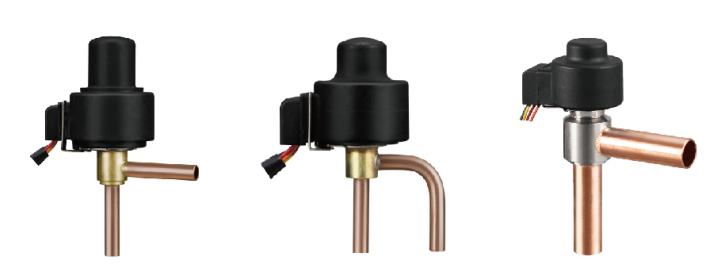
Scale in Chinese production is less about sheer volume and more about how quickly problems become visible. When a plant runs dozens of lines for the same valve family, a drift in spool clearance or seat flatness shows up within hours rather than weeks. Suppliers of ceramic billets, stainless bar stock and coil wire are close enough to adjust specs without long shipping delays, so tolerances can be tightened on the next batch instead of waiting for the next quarter.
That density also changes what factories can afford to check. In-line laser gauging, helium leak testing and automated pressure cycling are not reserved for a few premium units; they get built into the normal flow because the output can support the equipment. Operators see enough volume to recognize a 0.02 mm shift by sound and feel, and that tacit knowledge feeds back into fixture design and assembly sequences.
The result is not a different physics but a more consistent execution. Electronic valves come off the line with repeatable response times, lower internal leakage and longer seat life, not because a single worker is more careful, but because the surrounding system makes precision cheaper to repeat. Small design changes can be trialed on one line, measured against thousands of cycles, and rolled out across others within days.
Superheat Response That Anticipates Rather Than Corrects
Most control loops chase the error after it shows up, but this superheat response works differently. It reads the direction of change in evaporator load, refrigerant distribution, and expansion valve position before the outlet temperature can drift far enough to matter. The result is a system that holds the coil near ideal conditions without the usual sawtooth hunting.
That anticipatory behavior comes from treating superheat not as a fixed target, but as a moving zone. Instead of waiting for a low-side temperature swing to trigger a correction, the loop uses short-horizon trends to nudge valve opening early. On sudden load changes, the response feels less like a series of corrections and more like a continuous adjustment.
The practical benefit is quieter operation. Compressor floodback risk drops because the valve rarely overcorrects, and energy waste from excessive superheat stays low without repeated tuning. Maintenance calls also settle down since there is less oscillation, fewer frost bands, and fewer thermal cycles working against the expansion device.
Why Stepper Motor Noise Is Now a Design Priority in Residential Units
A decade ago, a faint whine from an HVAC damper or smart lock was easy to ignore because those devices lived in hallways, basements, or utility closets. Now the same stepper motors are showing up in bedroom blackout shades, adjustable bed bases, room-by-room zoning dampers, and even refrigerator air ducts. That puts the sound source a few feet from someone's pillow, where a 40 dB hum that was once buried by household background noise becomes the loudest thing in the room at 2 a.m.
The noise itself is not a single tone but a mix of electrical commutation ripple, mechanical resonance from the rotor, and vibration transmitted into plastic housings. Manufacturers used to treat those peaks as acceptable because the end user rarely noticed them in a busy kitchen or laundry area. In a quiet bedroom, however, the same drive current creates an audible chatter that shifts with speed ramping and microstepping settings. Reducing it now requires changes to current waveforms, bearing preload, damper materials, and firmware acceleration curves rather than simply adding a thicker cover.
Residential product teams also face tighter power and cost limits than industrial designers, so they cannot default to oversized drivers or bulky isolation mounts. This has made acoustic performance a design input alongside torque and footprint. Brands that ignore it risk returns from buyers who describe an otherwise functional shade or vent as cheap or broken solely because the motor can be heard. In multi-unit buildings, the issue spreads across walls and floors, giving property developers another reason to specify quieter motion hardware early in the project.
Low-GWP Refrigerants Push Metering Logic Into Unfamiliar Territory
Many low-GWP blends bring enough temperature glide that a coil no longer has one clean saturated temperature. A conventional expansion valve tuned around a single evaporating point now watches the reference wander as lighter and heavier fractions boil off at different rates. Superheat readings can look normal on a manifold while the actual refrigerant feed is off, simply because the assumed evaporating temperature has moved a few degrees.
A2L-class refrigerants tighten the picture further. Charge restrictions, mandatory leak checks, and rapid isolation mean the metering device is no longer a standalone component. It gets pulled into pump-down sequences, safety interlocks, and low-charge operation where holding a stable superheat is less important than keeping the compressor within its approved envelope. Mechanical valves can struggle with that wider operating map, so electronically driven metering becomes the practical baseline.
The emerging fix is not a better fixed setpoint but a control loop that tracks where the blend is within its glide. Pressure and temperature pairs give the controller enough information to shift the target superheat as operating conditions move. For technicians, that changes familiar symptoms: an unstable frost pattern or a wandering discharge temperature may now indicate the controller deliberately following a changing evaporation profile rather than a system fault.
From Assembly Line to Heat Pump Without Losing Field Consistency
Shifting a line that once built standard air handlers over to heat pump production sounds like a straightforward product change, but the real friction shows up in the details: brazing stations need different filler metals, vacuum drying has to hold tighter moisture limits, and wiring crews suddenly face inverter boards where contactors used to sit. The line doesn't get to pause for retraining, so consistency has to be built into the station layout and torque specs rather than left to individual memory.
What keeps field performance predictable is not a new set of work instructions alone. It is the way those instructions are tied to the physical line, with color-coded fittings, go/no-go gauges at the brazing bench, and serial-number tracking that follows each coil from tube bending through final charge. When the same defects show up across shifts, the fix usually lives in a fixture or a sensor trip, not in another reminder to be careful.
The goal is to make the transition feel less like switching product families and more like narrowing the line's allowable variation. If an installer opens a heat pump and finds the same routing, the same labeling logic, and the same leak-check port placement as the previous unit, the factory has done its job. Consistency in the field starts at the station where someone decides whether a braze joint is good enough.
FAQ
The shift is mainly from fixed-orifice and pulsing stepper-motor valves to high-resolution linear actuators with closed-loop control. That lets the valve continuously tune refrigerant flow instead of hunting between fixed positions, which used to create small temperature swings.
It gives the system a finer throttle. The controller can compare real-time superheat, suction pressure, and discharge temperature, then adjust the valve in milliseconds. The result is less overshoot, fewer compressor stops, and steadier room conditions.
Partly because heat pump adoption is rising and building codes are tightening efficiency targets. A responsive expansion valve is one of the cheapest ways to boost seasonal performance without replacing compressors or heat exchangers, so the development payoff is fast.
Part-load is where traditional systems lose the most. With better valve modulation, the evaporator stays closer to its optimal fill level even when demand drops, so the compressor doesn't have to work against unstable pressures or cycle on and off as often.
They are generally built with broader pressure-temperature envelopes and materials that tolerate the mild flammability and different oil solubility of A2L refrigerants. Some also include internal sensing that compensates for refrigerant-specific behavior, which reduces retuning work for OEMs.
A meaningful amount. Because the valve reports position and superheat trends continuously, a connected system can spot gradual fouling, charge loss, or sensor drift before comfort suffers. That turns many emergency calls into planned, low-cost inspections.
The upfront cost is higher than a capillary tube or thermal expansion valve, and the control logic needs proper commissioning. But in variable-speed and multi-zone systems, the energy savings and better humidity control usually outweigh the added complexity within a few seasons.
Check hysteresis, minimum stable opening, response time, and how well the valve communicates with common controllers. Also look for real test data at low ambient heating and high ambient cooling, because those are the conditions where valve quality shows up most.
Conclusion
Chinese electronic expansion valves are now closing a long-standing gap between compressor speed changes and refrigerant feed. Instead of treating the valve as a simple restrictor, manufacturers tune its stroke, seat geometry and stepper resolution so that mass flow follows inverter-driven compressor ramps almost immediately. Tight production tolerances from large-scale manufacturing allow this precision to be repeated across thousands of units, not just in lab samples. At the same time, superheat control has shifted from correcting a deviation after it appears to reading the early pressure and temperature signals that precede hunting. The result is a calmer evaporator, better part-load efficiency and fewer liquid floodback events in variable-speed heat pumps.
Residential noise requirements are also reshaping valve design. Stepper motor whine and clicking, once accepted in commercial equipment, now receive the same attention as compressor sound in ducted and ductless systems. Chinese suppliers have responded with damped rotor assemblies and gentler drive waveforms, cutting audible stepping without sacrificing positioning accuracy. The move to low-GWP refrigerants adds another layer of difficulty: R290, R32 and similar fluids have different density and glide behavior, pushing metering logic into operating ranges where older valve curves become unstable. Field consistency is maintained by automated calibration at the end of the assembly line, where each valve's flow signature is mapped and matched to the intended heat pump platform. That reduces the tuning burden on installers and keeps performance closer to factory expectations after commissioning.
Contact Us
Contact Person: KOPASS HO
Email: [email protected]
Tel/WhatsApp: 8613606566112
Website: https://www.hongsenref.com/