

Electrical Slip Ring Manufacturer Guide: Choosing High-Performance Rotating Connectors
2026-08-11
In applications demanding uninterrupted power and signal transfer across rotating interfaces, the choice of slip ring manufacturer directly impacts system reliability and lifespan. From wind turbines to medical imaging, every industry has unique requirements for electrical slip rings, and navigating the options can be daunting. This guide cuts through the complexity, offering practical insights into selecting high-performance rotating connectors that match your technical and environmental demands. As a leader in the field, MOFLON has pioneered robust, application-specific solutions that outperform generic alternatives. Whether you're tackling high-speed data transmission or harsh operating conditions, the right engineering partner makes all the difference. Read on to discover key criteria that will save you time, reduce costs, and ensure your system's success.
Matching Slip Ring Specifications to Your Design’s Power and Signal Needs
Every slip ring begins with a fundamental mismatch: your design demands seamless transmission of power and data, yet standard off-the-shelf units often treat these as separate afterthoughts. To align a slip ring with your specific needs, start by mapping the exact current per circuit and the type of signals—whether low-level analog, high-frequency digital, or both. A slip ring that comfortably handles your peak power draw without thermal drift, while rejecting crosstalk between adjacent channels, is not a commodity but a tailored component. The interplay between conductor cross-section, ring spacing, and brush composition determines whether your system hums along quietly or stutters under load.
Signal integrity often becomes the quiet dealbreaker. When gigabit Ethernet or sensitive sensor outputs share a rotating interface with high-current paths, inductive coupling can corrupt data long before you see visible wear. Specifying separate signal rings, layered shielding, or even twisted-pair modules inside the ring body can preserve eye diagrams without over-engineering. Pay attention to bandwidth ratings that reflect real-world bit error rates, not just ideal lab conditions. In practice, this means involving your slip ring partner early, sharing not just voltage and current but also signal waveforms and allowable attenuation, so the final assembly fits mechanically and electrically without last-minute compromises.
Why Material Choices Define the Lifespan of a Rotating Connector
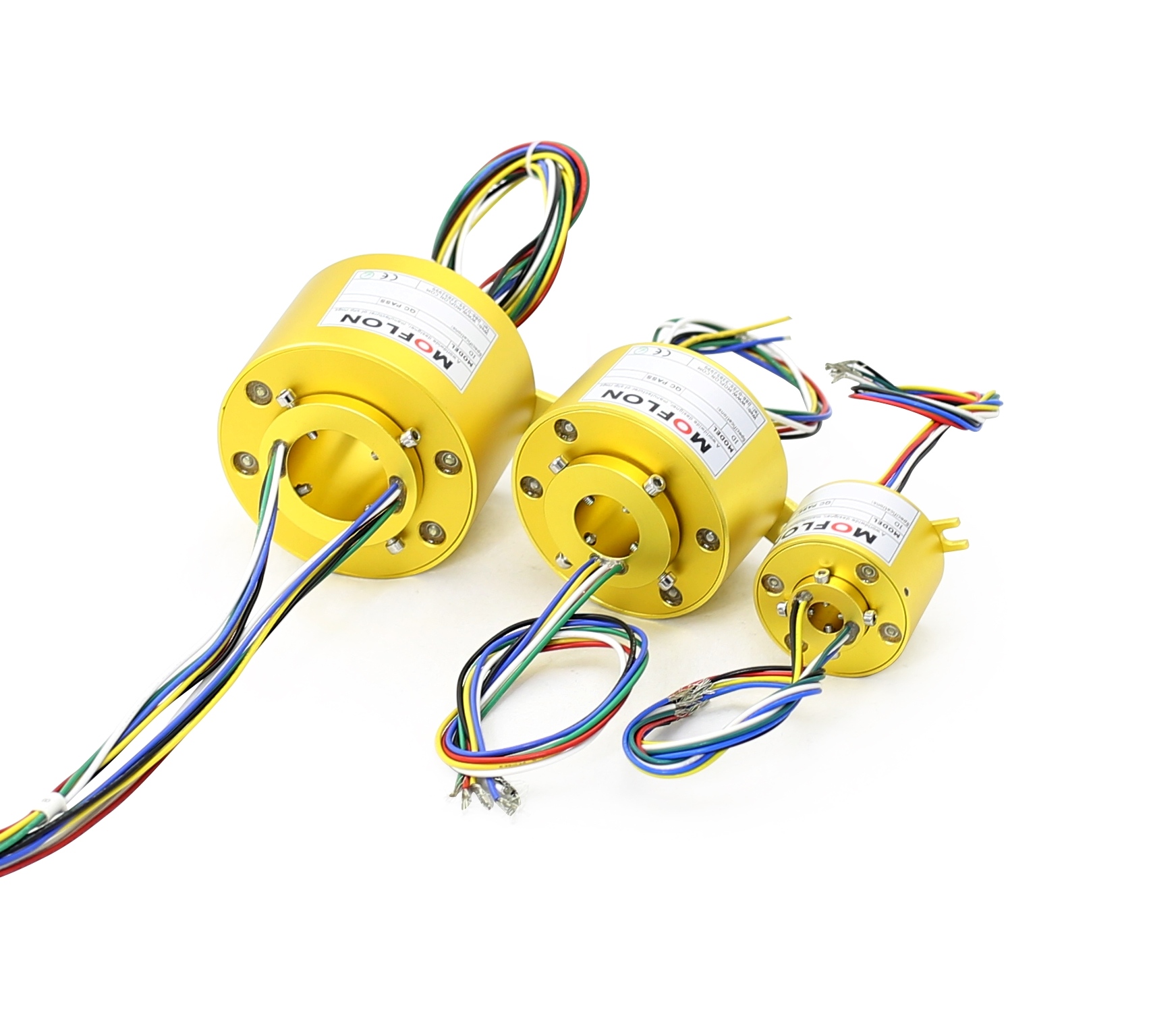
The materials inside a rotating connector aren’t just passive ingredients—they actively determine how long the component will last under stress. Every rotation, every temperature swing, every minor vibration tests the limits of the chosen metals, polymers, and coatings. A connector made with standard brass might wear smoothly for a while, but introduce corrosive fluids or high humidity, and it begins to degrade at the contact points, leading to intermittent signals and eventual failure.
Consider the plating on the contact rings. A thin layer of gold over nickel can resist oxidation and maintain low electrical resistance, but if the gold is too soft or poorly bonded, it can flake off under repeated sliding, exposing the base metal and accelerating wear. On the other hand, using a hardened alloy with self-lubricating properties might trade some initial conductivity for long-term mechanical stability, which often matters more in industrial machinery.
The wrong material pairing can create galvanic corrosion, turning a sterile electrical connection into a tiny battery whenever moisture gets in. That subtle rust grows, increasing resistance, generating heat, and eventually seizing the rotation entirely. Smart designers match materials not just for their individual strengths, but for how they behave together over hundreds of thousands of cycles—because in a rotating connector, the lifespan is rarely decided by one part failing alone; it’s the slow dance of wear and chemistry that finally calls time.
Environmental Sealing: More Than Just an IP Rating
When engineers talk about environmental sealing, the conversation often starts and ends with an IP rating. While these two-digit codes provide a useful shorthand for dust and water resistance, they only scratch the surface of what real-world sealing involves. An IP68 rating might guarantee survival after a 30-minute dunk in still water, but it says nothing about chemical exposure, thermal cycling, or the relentless vibration a connector endures on a factory floor. True environmental sealing demands a broader perspective—one that considers material compatibility, seal compression set over time, and the sheer unpredictability of operating conditions.
Consider the gaskets and O-rings doing the actual work. Their performance isn’t static; it degrades subtly as temperatures swing from freezing cold to near-boiling, or as they absorb traces of hydraulic fluid and cleaning agents. A design that passes a lab dunk test can still fail after months of thermal expansion and contraction, which gradually relaxes the seal’s grip and opens microscopic leak paths. Real reliability comes from selecting elastomers that resist not just water, but the specific oils, solvents, and UV exposure present in the application. It also means designing housings that shield seals from direct sunlight and physical damage, because once an O-ring develops a nick or a surface crack, even the highest IP rating becomes meaningless.
Environmental sealing isn’t a checkbox—it’s a systems-level challenge. The overlap between mechanical design, materials science, and application-specific stress factors defines whether a product thrives in the field or gets returned under warranty. Beyond the lab bench, successful sealing faces rain that drives sideways into connector faces, washdowns with aggressive detergents, and altitude changes that create internal vacuums. These scenarios aren’t captured by an IP code, yet they’re the difference between a long service life and a silent, moisture-induced circuit failure. Smart engineers treat the rating as a starting point, then build in margin with double-seal barriers, weep holes for condensation, and rigorous testing that mimics real abuse.
Customization Without the Complexity: Tailored Solutions That Actually Deliver
Too often, customization gets tangled in endless configuration screens and convoluted processes that drain time and enthusiasm. What should feel like a razor-sharp fit for your workflow instead becomes a project in itself—one that pulls you away from actual work. The real promise of tailored solutions is simplicity: they should slide into your operations without friction, not create new bottlenecks.
That’s why we strip away the non-essentials. No sprawling feature lists, no one-size-fits-all frameworks masquerading as “flexible.” Every tweak and adjustment is done with a clear line of sight to the outcomes you care about—whether it’s faster turnaround, clearer data, or just a tool your team actually enjoys using. The process is built around conversations, not committee approvals, so the finish line stays near.
What lands at your doorstep isn’t a half-baked prototype or a maintenance nightmare. It’s a finished, cleanly integrated piece that delivers from day one. When tailored solutions truly deliver, they don’t announce themselves with fanfare—they quietly make the hard parts of your day disappear. That’s customization without the weight.
Installation Pitfalls That Compromise Slip Ring Performance
Aligning a slip ring with excessive force or at a slight angle during mounting warps the rotor and strains internal bearings, leading to uneven brush contact and accelerated wear. Many installers overlook the need for a pilot bore or flexible coupling that absorbs minor misalignments, instead hard-bolting the unit directly to a shaft that may have run-out. That rigid connection transmits every vibration and imperfection, quickly degrading the ring surface and causing intermittent signal dropouts.
Another common misstep is ignoring the manufacturer's torque specifications when tightening mounting hardware. Over-tightening deforms the housing and can bind the rotating assembly, while under-tightening allows micro-movements that fret the mating surfaces and generate conductive debris. Combined with cables that are pulled taut rather than routed with a service loop, these subtle stresses accumulate until the slip ring's electrical noise spikes or a channel fails entirely mid-operation.
Contamination during installation often goes unnoticed but is just as damaging. Fingerprints on the contact rings deposit oils that attract dust, and failing to seal cable entry points invites moisture or cutting fluid from the surrounding machinery. Once inside, that grime mixes with brush residue to form a gritty paste that insulates the contacts and causes pitting. A clean assembly environment and simple protective covers during final placement make a substantial difference in how long the slip ring maintains a clean, stable connection.
From Robotics to Wind Turbines: What Different Applications Demand
Engineering systems look remarkably different once you step away from the bench and into the field. A laboratory robot arm that assembles circuit boards demands micron-level repeatability and cleanroom compatibility. The same core technologies—motors, sensors, control algorithms—appear in a wind turbine, yet the priorities flip entirely. Out on a North Sea wind farm, survival in salt spray and 50-meter-per-second gusts matters more than sub-millimeter positioning. This divergence isn't incidental; it reshapes everything from material choices to maintenance intervals.
Consider how motion control shifts across domains. In semiconductor manufacturing, direct-drive linear motors eliminate backlash because even 100-nanometer jitter ruins a wafer. Wind turbines, by contrast, use geared drivetrains that tolerate lash but must handle abruptly reversing torque loads while yawing into the wind. Lubrication alone tells the story: robotic joints use thin synthetic greases for low outgassing, while main shaft bearings in a 10-megawatt turbine require tacky, water-washout-resistant compounds that stay in place despite constant vibration. The design briefs barely overlap.
Other industries push those boundaries further. Surgical robotics borrows heavily from aerospace flight-control redundancy—if a servo glitch could injure a patient, fail-operational architectures become non-negotiable. Agricultural pick-and-place machines invert robotic cleanliness standards: sealed housings shed mud and pesticides, while vision systems must function under direct sun bouncing off wet leaves. Each of these applications doesn't just select from existing components; it forces suppliers to reimagine what a bearing, a sensor, or a power stage can endure. The real engineering challenge lies in recognizing which specs actually govern the end use and which are just laboratory habits.
FAQ
Look closely at the operating speed, number of circuits, current and voltage ratings, and dielectric strength. You'll also want to match the ring's materials to your environment—gold-on-gold contacts work well for low-current signals, while silver-graphite handles higher power. Don't overlook the housing protection rating if it's going into dusty or wet conditions.
Start by mapping out what needs to rotate—power, analog signals, digital data, or fluid. Capsule slip rings suit compact spaces with moderate circuit counts, while through-bore designs let you route shafts or pneumatics through the center. For very high RPM or harsh vibration, pancake or separate rotor-stator assemblies often hold up better.
A slip ring transfers electrical signals and power across a rotating interface, while a rotary joint (or rotary union) does the same for fluids—hydraulic oil, coolant, air. Some modules combine both into a single unit if your machine needs simultaneous electrical and media transfer.
The big killers are contamination, improper mounting, and running outside the rated speed or temperature. Even a tiny bit of dust on the ring surface can spike electrical noise. Use sealed units when possible, keep alignment within the manufacturer's spec, and if you're pushing the max RPM, ask about forced-air cooling or premium contact alloys.
Yes, but you need to segregate the circuits carefully. High-current power can induce noise in adjacent data lines, so look for designs with internal shielding or dedicated compartments. For Gigabit Ethernet, make sure the slip ring's bandwidth and crosstalk specs match your network requirements—don't just assume it'll work.
They should do more than just quote a part number. Expect detailed torque and life calculations based on your actual load profile, samples for fit-checking, and honest advice about trade-offs—like whether you really need a 30-circuit ring or could multiplex signals to save space and cost. Fast, direct engineering support without layers of sales fluff is a good sign.
Conclusion
Selecting a high-performance slip ring starts with a precise alignment between the unit’s specifications and your system’s power and signal demands. Under-specifying current capacity or ignoring the subtle impedance requirements of high-speed data lines often leads to intermittent faults that only surface after deployment. Equally critical are the materials inside the rotating connector: gold-on-gold contacts may be ideal for low-current signal fidelity, while silver-graphite composites excel in heavy industrial currents, directly dictating how many million revolutions the ring can endure before wear becomes measurable. Real-world longevity is rarely just datasheet theory—it’s a marriage of the right contact pairing and a robust mechanical design that handles thermal expansion without compromising the brush tension.
Beyond the contact zone, environmental sealing must be viewed through the lens of your actual operating conditions, not just an IP code. A turbine slip ring rated IP65 might survive occasional rain but fail rapidly in high-humidity, salt-laden offshore air if the breather drains aren’t designed to expel condensation. Customization doesn’t have to mean complex, delayed projects: experienced manufacturers now offer modular platforms where you can mix power channels, Ethernet paths, and fluid rotary unions without a complete redesign. Installation is another decisive factor—over-tightening a hollow shaft mount can distort the housing and accelerate brush skip, while cable strain relief is frequently neglected until vibration loosens a connector. Across applications as diverse as surgical robots and multi-megawatt wind turbines, the common thread is that each slip ring must be treated as a system component, not a generic accessory, with attention to duty cycle, maintenance access, and the specific type of debris or vibration it will face every day.
Contact Us
Contact Person: Xiangpin Li
Email: [email protected]
Tel/WhatsApp: 86 186 1706 8578
Website: https://www.moflon.com