

Inkjet Printer Inks Factory: Quality Manufacturing Insights
2026-09-30
Behind every crisp barcode and vivid product label lies a hidden world of precision chemistry and engineering. At Danmajet, we don’t just mix pigments—we craft inkjet inks that defy clogging, resist fading, and keep production lines humming. But what really separates a mediocre ink factory from a quality-driven one? In this post, we pull back the curtain on the manufacturing insights that power our inks, from raw material selection to rigorous batch testing.
What Really Happens in an Inkjet Ink Production Line
Most people picture giant vats of colored liquid being stirred, but the reality is far less forgiving. A pigment-based inkjet ink starts as a suspension of solid particles that want to clump, settle, and clog printheads. The first stage uses high-shear mixers to wet the pigment surface with dispersants and resins, pulling apart agglomerates before they ever reach a mill. This pre-dispersion step is where many formulations fail; if the wetting is uneven, no amount of grinding later will rescue the batch.
The liquid then moves into bead mills filled with ceramic beads no larger than a grain of sand. Recirculating through the mill for hours, the pigment particles are fractured and stabilized until the average size drops below 200 nanometers. It is not a set-and-forget process. Operators pull samples every thirty to sixty minutes, check particle size distribution, and adjust mill speed or temperature. After milling, the ink passes through a series of filters—often down to 0.5 microns—and a vacuum degasser to strip out dissolved air that would cause bubbles in the cartridge.
Finally, the batch is tested for viscosity, surface tension, pH, and electrical conductivity before being filled into cartridges or bulk containers. But the real test happens on a printhead simulator, where the ink must fire thousands of drops without a single missing nozzle. Pigment-based inks also go through accelerated aging at elevated temperatures to predict shelf life. If everything passes, the batch is released with a unique lot number, and the entire process starts again for the next color.
The Overlooked Role of Deionized Water in Print Quality
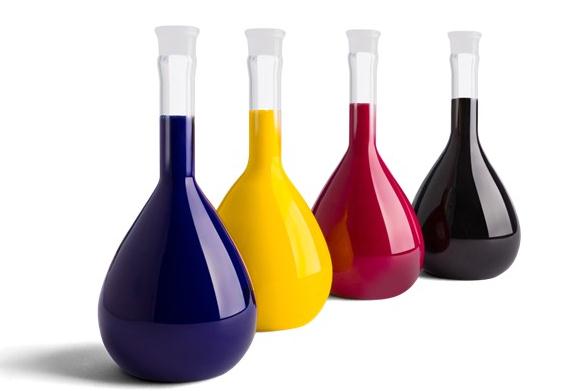
Most pressroom conversations revolve around inks, plates, and blankets, yet the water feeding the dampening system often gets a passing glance at best. Deionized water removes the calcium, magnesium, and chloride ions that are invisible in ordinary tap water. Those minerals do more than leave spots—they can react with fountain solution additives, shift the ink-water balance, and trigger scumming or toning on the plate. Simply looking clear is not the same as being chemically predictable.
When hard water meets the slightly acidic environment of a fountain solution, precipitates can form and coat rollers, metering systems, and plate surfaces. This disrupts the uniform film of moisture that keeps non-image areas clean. Printers may chase symptoms by adjusting ink feed or dampening settings, when the root cause is fluctuating water hardness. Deionized water stabilizes the baseline, allowing the fountain solution to perform as designed instead of fighting a moving target.
That said, not all deionized water is identical. Monitoring resistivity gives a better picture than relying on a label. Water that sits too long in storage can absorb carbon dioxide from the air, lowering its resistivity and reintroducing conductivity. A simple in-line check before the press run prevents the quiet drift that leads to dot gain and color shifts. In short, treating water quality as a process variable rather than an afterthought removes one of the most common hidden interference factors in print consistency.
Why Some Inks Clog Printheads and How We Prevent It
Inkjet printers rely on a delicate balance of fluid dynamics and microscopic nozzle geometry. When pigment particles settle or the carrier solvent evaporates too quickly, a stubborn residue forms along the inner walls of the printhead channels. This buildup narrows the pathway, forcing more pressure on the remaining nozzles until they either misfire or stop ejecting ink entirely. The problem worsens in low-humidity environments where the ink skin over within seconds of exposure to air, creating a crust that no amount of cleaning cycles can fully dissolve.
To keep this from happening, we focus on two fronts: ink formulation and maintenance behavior. Our inks use finely milled pigments with a narrow particle size distribution, plus humectants that slow drying without making the output sticky. On the printer side, we design the capping station to seal the nozzle plate completely when idle, and we schedule gentle purges at intervals that don't waste ink but still prevent stagnation. For users, we recommend printing a full-color test page at least once a week—not just a nozzle check, but actual coverage—so every channel gets flushed with fresh fluid. Skipping this small habit is the single most common reason we see clogged heads in otherwise healthy printers.
Color Matching Under Different Lighting Conditions
You've probably picked a "warm beige" swatch under showroom spotlights only to find it turns almost pink at home. This isn't your imagination—lighting rewrites color. Incandescent bulbs lean yellow, fluorescents often add a green cast, and north-facing daylight shifts things cooler. When the spectral makeup of the light changes, so does the set of wavelengths bouncing off a surface, which means the same pigment can produce noticeably different color sensations.
The real headache comes when you need two materials to match across different lamps. Metamerism is the term for colors that agree under one light source but drift apart under another. A fabric and a plastic button might look identical in daylight, yet under LED strip lights one looks muddy. That's why professionals don't trust a single viewing condition. They evaluate under a standardized illuminant like D65, and they often check with a spectrophotometer rather than eyeballing it, because our eyes adapt and mask differences.
If you're choosing paint, textiles, or printed materials, start by looking at samples in the actual environment where they'll live. Move them around: morning sun, evening lamps, overhead LEDs. For rooms with mixed lighting, softer or less saturated colors tend to be more forgiving. When an exact match matters—say, between a logo decal and a painted wall—ask for physical samples and view them side by side under at least three different light sources before committing.
The Economics of Small-Batch Ink Manufacturing
The financial backbone of small-batch ink production rests on accepting higher per-unit costs in exchange for pricing freedom. Buying pigments, resins, and solvents in limited quantities rarely earns volume discounts, and manual filling or labeling adds labor expense that automated lines would eliminate. Yet these same constraints open room for limited-run colors and rapid formula tweaks, which mass-market producers can't match. A maker might release 300 bottles of a seasonal sheening ink, price it at $22, and sell out within days simply because scarcity and specificity carry weight with enthusiasts.
Cash flow behaves differently at this scale. Instead of warehousing thousands of units, a small operation often produces to order or in short cycles, keeping raw material stock lean but agile. Shipping direct to consumers through a website or at pen shows removes distributor and retailer cuts, which can offset the lack of scale. The risk sits in demand forecasting: a single unpopular color can strand costly ingredients, while a surprise hit may require scrambling to reorder supplies at premium freight rates. Many successful micro-brands mitigate this by pre-selling limited editions or using subscription models to smooth revenue.
Profitability, then, hinges less on volume and more on margin discipline plus community connection. When buyers perceive a bottle as a crafted object rather than a commodity, they tolerate higher prices, but that tolerance demands consistent quality and a distinct voice. Small-batch ink makers often invest heavily in batch testing and hand-inspection, which raises costs further yet prevents the reputation damage of a contaminated or inconsistent batch. Over time, the economics reward those who balance ingredient costs, labor, and a clear brand identity against the inherent inefficiencies of staying small.
Scaling Ink Production from Lab Beaker to Factory Floor
The move from a beaker to a full-scale reactor changes how every ingredient behaves. What works with a magnetic stir bar rarely translates directly to a 500-gallon vessel. Pigment dispersion is the first wall you hit: shear forces in a lab mixer are nothing like those in a production bead mill, so the same formula can end up with a completely different color strength or gloss. You need to map viscosity as a function of shear rate, not just take a single Brookfield reading, and adjust dispersant levels accordingly. Temperature control also shifts; a small exotherm is easy to handle on a bench, but in a large batch it can kick off unwanted side reactions or destabilize the suspension.
Pilot runs are where most surprises surface. Running a 50-liter trial before committing to 2,000 liters lets you catch things like foaming, settling, or filter blinding that don't show up at lab scale. You also have to rethink raw material handling: pumping high-viscosity resins and pre-dispersed pigments through pipes is a different beast from pouring them into a beaker. Inline quality checks—measuring particle size, tinting strength, and rheology as the batch circulates—give you a better picture than sampling from the top. Often the fix is not changing the chemistry but changing the order of addition or the mixing time profile.
Once the process is stable, the last mile is reproducibility. You can't rely on a technician's feel for when the grind is "done"; you need defined torque curves, temperature logs, and pass counts through the mill. Cleaning between batches becomes a bottleneck if the same equipment runs water-based and solvent-based inks, so scheduling and flush protocols matter as much as the formula. Document everything from raw material lot variations to ambient humidity, because a batch that works in winter can fail in summer. At the end, scaling ink is less about replicating a recipe and more about building a robust process that tolerates real-world noise.
FAQ
Pigment dispersion stability is the real battleground. Factories that invest in custom-milled pigments and carefully matched dispersants avoid the settling and nozzle clogging that plague cheaper formulations. The resin system also matters more than most buyers realize, because it controls how well the ink binds to different substrates over time.
It starts with gravimetric dispensing rather than volumetric, so tiny density shifts don't throw off the recipe. Then each batch is tested against a retained reference sample using the same printers and media that customers actually run. That kind of closed-loop comparison catches drift long before it reaches a printhead.
Sequential depth and membrane filtration down to 0.2 microns is the practical standard. The goal is not just removing visible particles but also reducing oversized pigment aggregates that can pass initial tests yet still erode nozzle plates over hundreds of hours.
Yes, and the most effective moves are often invisible. Recovering and reusing wash water, switching to bio-based co-solvents, and designing concentrates that ship with less water all lower the footprint. The key is validating each change through accelerated aging and jetting tests so the eco-friendly version meets the same specs.
Ask to see their deviation log, not just a certificate. A factory that openly tracks and reviews every out-of-spec batch shows a mature quality system. Also ask how they handle raw material supplier changes, because even a small shift in a pigment or surfactant source can change jetting behavior.
They tune viscosity, surface tension, and evaporation rate around the printhead's firing frequency and nozzle geometry. For example, a thermal printhead needs inks that tolerate rapid heating without kogation, while a piezo head gives more freedom on solvent choice but demands tighter control of acoustic properties.
Conclusion
Walk into an inkjet ink factory and the first thing you notice is that production is less about mixing colorful liquids and more about controlling invisible variables. From raw pigment dispersion to final filtration, every step on the line is designed to remove particles larger than a micron. But one input that rarely gets attention is deionized water. Its conductivity must stay extremely low because trace ions can destabilize pigments or interact with dyes, causing shifts in color or unwanted residue. Water quality also affects viscosity and surface tension, which in turn shape droplet formation and print sharpness. Then there is the constant fight against clogging. We don't just rely on a final filter; we monitor dispersion stability, use controlled milling times, and run accelerated aging tests to catch any tendency for agglomeration before a batch leaves the floor.
Color matching is another quiet battleground. A print that looks perfect under cool factory lighting may shift under warm retail lights or daylight, so we evaluate batches under D50 and several other illuminants and keep tolerances tight enough to avoid metameric failure. For small-batch runs, the economics are unforgiving: changeover cleaning, waste disposal, and QC time can eat the margin if we aren't careful. That is why scaling from a lab beaker to a factory vessel is rarely a straight line. Shear rates differ, cooling times change, and additive order can alter final performance. We deliberately run pilot batches that mimic production energy input, not just formula ratios. The goal is to make every cartridge, regardless of size or batch, behave like the one the customer tested months ago.
Contact Us
Contact Person: Jacky
Email: [email protected]
Tel/WhatsApp: 086 15000607053
Website: https://www.danmajet.com