
Known Tire Shredder Technologies for Efficient Recycling
2026-05-12
Tire recycling is more critical than ever, yet the efficiency of the process depends heavily on the shredding technology in use. From massive whole-tire shredders to advanced granulators, the industry has developed a range of specialized machines to transform waste rubber into valuable resources. But with so many options, how do you know which technology fits your operation? In this post, we’ll break down the most effective tire shredder technologies available today and explore how innovators like Shengzhong Shredder are pushing the boundaries of performance and reliability.
Crunching Earthmover Tires with Heavy-Duty Dual-Shaft Shredders
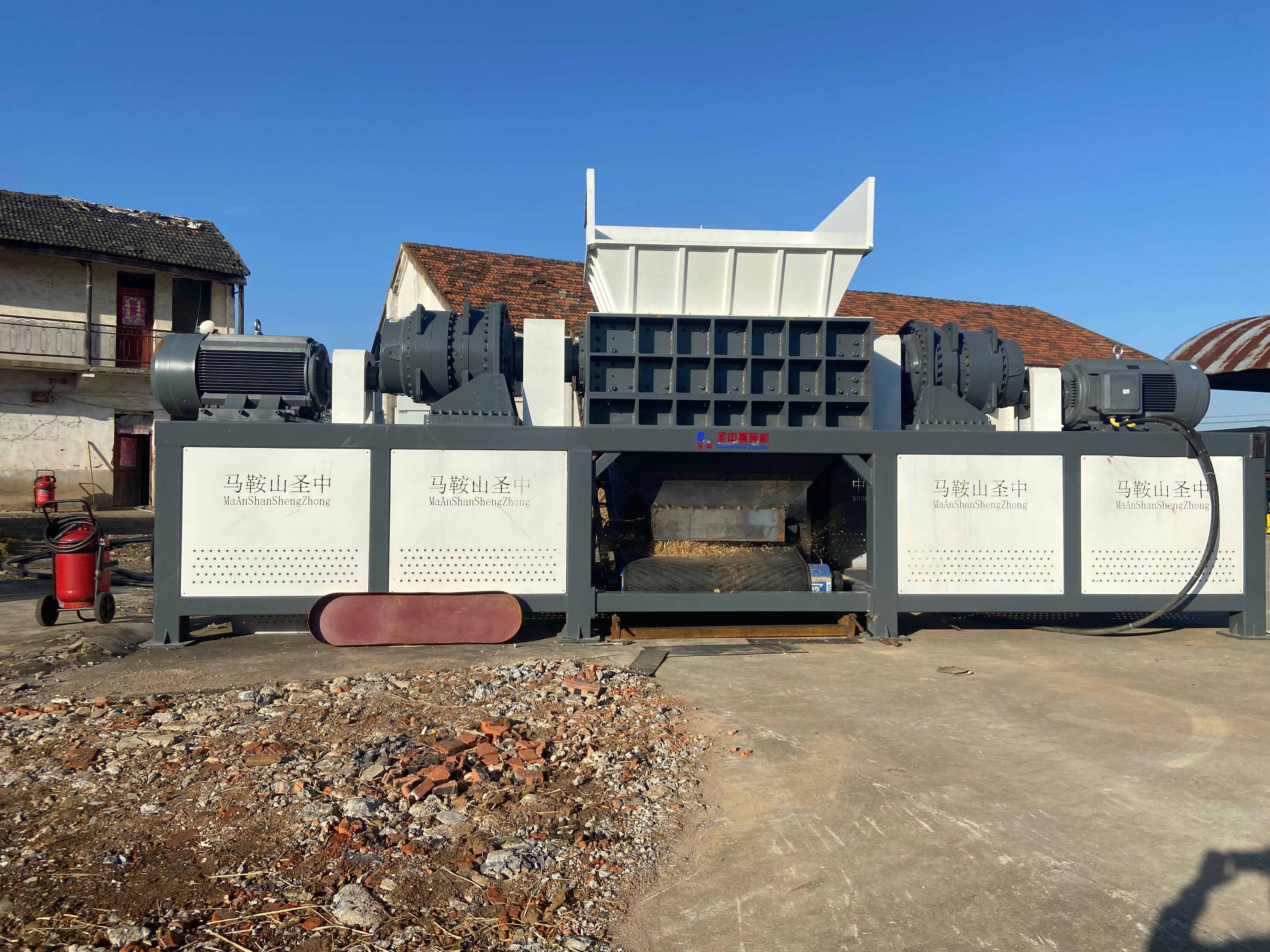
Old earthmover tires are notoriously tough to handle. Their sheer size, reinforced steel belting, and rugged rubber compounds laugh at ordinary equipment. When these giants have reached the end of their road, getting them into a form that’s manageable for recycling or disposal demands a serious machine. That’s where a dual-shaft shredder built for brutal workloads steps in, making quick work of what others can’t even dent.
The process is both violent and controlled. Hydraulically driven cutting discs grab and pull the tire inward, tearing through lug after lug. Steel wires are ripped apart, rubber chunks peel away, and the entire mass is steadily reduced without the need for pre-cutting. The low-speed, high-torque design means less dust and fewer sparks, while the reversible shafts let the operator clear jams by simply running the rotors backward—no climbing onto the machine with a pry bar.
What comes out the discharge side is a coarse, uniformly sized shred that can be fed directly into granulators or used as tire-derived fuel. The dual-shaft geometry prevents the wrapping and long strips that single-shaft machines often produce, keeping downstream equipment happy. For sites dealing with dozens of scrapped loader and dump truck tires each week, this kind of shredder turns a monumental headache into a straightforward, low-drama operation.
Cryogenic Grinding Breakthroughs Yield Ultrafine Rubber Powder
Recent advances in cryogenic grinding have redefined the production of rubber powders, pushing particle sizes into the ultrafine range that was once commercially unattainable. By chilling scrap rubber well below its glass transition temperature with precisely controlled liquid nitrogen flows, new mill designs overcome the heat buildup that historically degraded material. The result is a consistent sub-100-micron powder with minimal surface oxidation, preserving the polymer’s original elasticity and reactivity far better than ambient grinding ever could.
This leap in powder quality opens up high-value applications that previously relied on virgin materials. In automotive seals and gaskets, the ultrafine particles disperse uniformly into thermoplastics, improving shock absorption without creating weak spots. Tire manufacturers are also exploring its use in tread compounds, where the fine powder blends smoothly with fresh rubber to reduce hysteresis losses—translating directly into better fuel efficiency without sacrificing wear life.
Beyond performance gains, the process brings a genuine sustainability edge. Because no chemical pretreatment is needed and energy consumption per kilogram has dropped sharply with optimized pre-coolers, the overall carbon footprint is remarkably low. Recyclers can now profitably convert end-of-life tires and technical rubber goods into a powder that challenges synthetic fillers on both price and function, closing a loop that had frustrated the industry for decades.
Clean Separation of Steel and Rubber in Single-Shaft Shredding
Single-shaft shredders have become essential in recycling operations where the goal is to separate steel from rubber with minimal cross-contamination. The controlled cutting action reduces material into uniform particles, which is the first step toward effective segregation. Unlike dual-shaft machines that can produce irregular chunks, the single-shaft design yields consistent sizing that allows downstream separators to work more efficiently.
After the shredding phase, integrated magnetic systems capture ferrous metals while air separation or density-based methods isolate rubber particles. The precision of a single-shaft shredder means steel wires are often stripped clean of rubber, reducing the need for additional cleansing stages. This not only saves energy but also preserves the integrity of both material streams—the rubber remains free of metal fines, and the steel retains its value for smelting.
What sets this approach apart is how the shredder’s rotor and screen configuration can be tuned to match specific materials. Operators can adjust settings to ensure that tough rubber does not wrap around steel components, preventing blockages and downtime. The result is a steady flow of separated outputs, which can be sold directly to processors without secondary sorting. In large-scale tire recycling, this clean separation directly impacts profitability by lowering labor and equipment costs.
Shear Blade Geometries That Maximize Throughput per Hour
The shape of a shear blade directly governs how efficiently material separates under load. By shifting from a simple flat edge to a hollow‑ground or convex profile, engineers can reduce cutting resistance and allow the blade to penetrate with less force. This lower resistance means the machine cycles faster—often cutting milliseconds from each stroke—and those savings compound into noticeably higher hourly throughput.
Angular contact patterns also play a major role in throughput optimization. A blade designed with a progressive shear angle, rather than a straight chop, engages the material gradually, distributing stress across a narrower zone at any instant. The result is a smoother cut that avoids stalling the drive and permits a higher stroke rate without sacrificing edge life. In high‑volume lines, this geometry alone can lift output by 10–15% while keeping power draw within rated limits.
To push throughput further, some designs incorporate multiple bevels or serrated sections that fracture the material in stages. The initial bevel starts the separation, a secondary land stabilizes the sheet, and a micro‑serration pattern finishes the cut before the blade fully closes. This staged approach prevents the jam‑and‑surge behavior common with single‑bevel tools and enables consistent cycle speeds even with variable material thickness. When matched to a specific stock width and hardness, these geometries unlock the maximum strokes per minute a given press can deliver.
Fully Integrated Systems Automate Tire Processing from Bead to Crumb
Modern tire recycling has shed its clunky past, thanks to fully integrated systems that handle every step without constant human intervention. From the moment a whole tire—bead, sidewall, and tread—enters the line, it’s gripped, shredded, and separated in one continuous flow. These setups combine primary shredders, granulators, and sophisticated screening modules that work in tight synchronization, leaving no room for bottlenecks. The idea is simple but transformative: feed in a mixed pile of end‑of‑life tires and collect clean rubber crumb, steel, and fiber at the other end, all while operators monitor from a distance.
What sets an integrated line apart is how it tackles the tough parts without breaking stride. The bead, often the most stubborn component, gets extracted early through dedicated debeaders or shear‑type shredders that don’t blink at thick steel bundles. As the material flows downstream, magnets and air classifiers pull out steel wire and textile fluff progressively, so the crumb coming off the final grinder is already purified. This kind of automation wasn’t possible a decade ago without constant jams and manual pick‑outs; now, sensors and self‑adjusting cutters keep things moving, even when the tire mix shifts from passenger to truck tires mid‑batch.
Behind the scenes, the true sophistication lies in control algorithms that link every machine. If the infeed rate spikes, the downstream separator fans speed up automatically—no one touches a button. It’s a far cry from the piecemeal yards where piles of partially processed rubber sit waiting for the next manual step. For plant operators, the payoff comes in a consistent crumb size that meets exact specifications, whether destined for playgrounds, asphalt modification, or molded goods. The system pulls together an end‑to‑end solution that not only slashes labor costs but also makes the entire process reliable enough to run around the clock, turning what was once a headache into a streamlined, predictable stream of revenue.
Mobile Shredding Units Bring Convenience to Remote Tire Piles
Dealing with old tires in far-flung locations used to be a logistical nightmare. Hauling heavy, unwieldy tire piles from off-the-grid sites to distant processing facilities consumed time and fuel, often making the whole effort economically unfeasible. Road access could be dodgy, and the sheer bulk of these rubber mountains meant that many simply sat untouched for years, becoming environmental and fire hazards.
Mobile shredding units have upended that old reality. These truck-mounted machines travel directly to the source, grinding tires into manageable chips on the spot. The shredded material can then be transported more efficiently or repurposed locally as construction fill, playground surface, or alternative fuel. It’s a practical, no-nonsense solution that turns a stubborn eyesore into an asset without the need for hauling whole tires across the map.
FAQ
The two big ones are ambient shredding and cryogenic shredding. Ambient does it at room temperature using high-torque knives, while cryogenic freezes the tires with liquid nitrogen first, making the rubber brittle enough to shatter into fine particles. You’ll also see variations like single-shaft, two-shaft, and four-shaft shredders tailored to different output sizes.
Ambient shredding relies on mechanical force at normal temperatures, so it’s simpler and cheaper to run but can produce more heat and wear on the blades. Cryogenic shredding uses extreme cold to make the rubber behave like glass, so it fractures cleanly with less energy overall. The trade-off is the cost of liquid nitrogen and a slightly different particle shape—cryogenic tends to give smoother surfaces.
They’re the workhorses that take whole tires and rip them into large chunks, usually 2-inch strips or smaller. This first pass makes the material manageable for downstream processes like granulation or steel separation. Without a solid primary shredder, you’d clog up the finer machinery.
It starts with feeding whole tires—sometimes still on rims—into a heavy-duty shredder. The machine’s rotating knives grab and tear the tire apart, reducing it to rough pieces. Those pieces then go through a screening system; oversize chunks get sent back for another pass. What passes through moves on to magnetic separation and further grinding if needed.
It sets the stage for everything else. If you don’t shred tires thoroughly and consistently, you end up with uneven material that gums up granulators or leaves rubber embedded with steel, which degrades the quality of end products like crumb rubber or pyrolysis feedstock. Efficient shredding also keeps energy costs in check because you’re not re-processing the same material repeatedly.
Look at blade durability and ease of access for maintenance, because downtime kills productivity. The feed mechanism should handle varying tire sizes without jamming. Power efficiency matters a lot, and you want a machine that produces a uniform output size right off the bat. Some newer models have smart controls that adjust speed and torque automatically to match the load.
We’re seeing more use of direct-drive motors that cut out gearboxes, reducing energy loss and maintenance headaches. Water-jet shredding is being explored as a dust-free alternative, though it’s not mainstream yet. Another push is integrating real-time monitoring that predicts blade wear and optimizes throughput, so operators aren’t guessing when to swap parts.
Conclusion
Modern tire recycling has moved far beyond simple granulation, embracing robust machinery tailored to specific challenges. Heavy-duty dual-shaft shredders stand as the frontline solution for colossal earthmover tires, using interlocking blades to tear through thick rubber and steel belts with relentless torque. Their effectiveness is amplified by refined shear blade geometries—angled edges and optimized hook patterns that grip material aggressively, boosting hourly throughput without sacrificing cut quality. When these massive shreds move downstream, single-shaft shredders take over, employing a single rotor and a sizing screen to achieve a clean liberation of steel from rubber. The process relies on precise knife-to-screen clearances, ensuring that ferrous wires are stripped bare while the rubber is reduced to uniform chips, ready for the next phase.
For applications demanding the finest particles, cryogenic grinding has become a game-changer. By freezing tire chips with liquid nitrogen, the rubber turns brittle, shattering into ultrafine powder under milling—a method that consumes less energy than ambient grinding and captures every ounce of material without heat degradation. The real ingenuity, however, lies in fully integrated systems that handle everything from debeading to crumb production under one intelligent control roof. These lines sequence shredding, magnetic separation, fiber removal, and screening into a continuous, automated flow, dramatically cutting labor and downtime. Even remote stockpiles are no longer an obstacle: mobile shredding units mounted on trailers bring the entire process directly to abandoned tire piles, converting a scattered nuisance into valuable feedstock on site. Together, these technologies mark a shift toward efficiency that is both practical and adaptable, pushing tire recycling into a smarter, more sustainable era.
Contact Us
Contact Person: Leon
Email: [email protected]
Tel/WhatsApp: 8615385558866
Website: https://www.shred-waste.com