

Shuttle Rotomolding Machines: Expert Guide to Choosing the Best for Your Production Line
2026-11-16
Shuttle rotomolding machines are the backbone of efficient, high-output production lines, but choosing the right one can feel overwhelming. With shifting market demands and tighter production targets, even a small mismatch in equipment can ripple into costly downtime. That's why we put together this guide—to help you make a confident, informed decision. Whether you're upgrading your current setup or planning a new line, understanding shuttle machine dynamics is critical. And if you're looking for a partner who brings real-world expertise to the table, Rising Sun has been engineering reliable solutions that align perfectly with these principles.
Matching Shuttle Rotomolder Size to Production Demands
Determining the ideal shuttle rotomolder size starts with a clear picture of your largest intended part. Arm length, mold swing diameter, and oven capacity must accommodate not just the dimensions but also the material flow and cooling requirements. Many facilities underestimate how a seemingly minor increase in part length can force a jump to a much larger frame, impacting both floor space and energy consumption.
Production volume shapes the equation in less obvious ways. A smaller machine running multiple shifts on smaller molds can outperform a single large unit in overall output, especially when factoring in changeover time. The number of arms and independent oven stations determines how much overlap you achieve between heating, cooling, and unloading—directly affecting cycle time and weekly throughput. Evaluating your demand peaks and mix of stock vs. custom molds helps lock in whether a two-arm or three-arm shuttle is the smarter long-term investment.
Infrastructure constraints often seal the decision. Existing bay height, foundation strength, and utility hookups can rule out certain sizes before a quote lands on the table. Rather than treating the rotomolder as an isolated purchase, smart operations run a full footprint simulation, mapping mold travel, raw material staging, and secondary finishing areas to maintain a steady flow. Matching machine to production demands becomes a question of continuous balance—leaving enough capacity to absorb growth without paying for idle hours today.
Oven and Cooling System Design in Shuttle Rotomolding
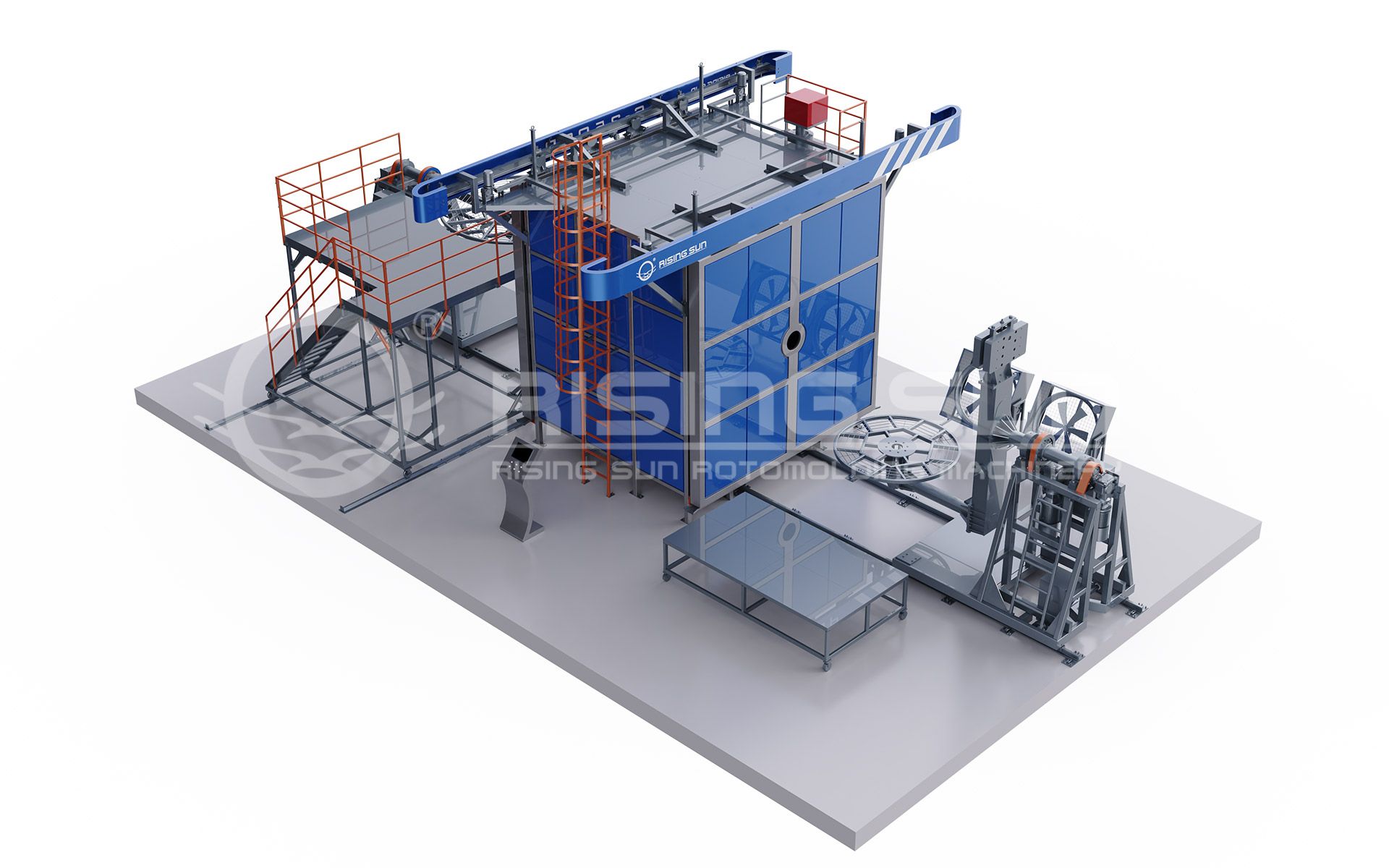
The shuttle rotomolding oven isn’t just a heated chamber—it’s a carefully calibrated thermal environment where control over air velocity, recirculation patterns, and zonal temperatures directly dictates part consistency. Unlike single-arm carousel machines that rely on a central burner, shuttle designs often integrate multiple independently controlled heating zones. This allows operators to tailor the heat profile to complex mold geometries, reducing the risk of localized scorching in deep cavities or bridging ribs. The oven’s combustion system typically combines high-efficiency forced-air burners with strategically placed baffles and returns, ensuring that the turbulent hot air reaches every fold of the mold without creating stagnant pockets. What sets shuttle systems apart is the ability to program the oven carriage’s linear motion, syncing it with the biaxial mold rotation for an even heat soak—especially critical when molding polyethylene parts with thick cross-sections.
Step out of the oven and into the cooling station, and the design challenges shift from managing heat to managing the rate at which it’s removed. Shuttle rotomolding often forces a choice between air-only cooling and hybrid air-mist systems, each with its own impact on part crystallinity and dimensional stability. Air-only systems deliver gentle, consistent cooling that suits amorphous or highly filled materials, but they can stretch cycle times. Adding atomized water to the airflow accelerates the process dramatically, yet it risks creating uneven shrink lines or warpage if the mist nozzles aren’t arranged to match the mold’s heat map. The best cooling stations incorporate proportional valves and variable-speed fans, dynamically adjusting the mist-to-air ratio as the mold temperature drops. A well-designed system also directs exhaust flow away from the oven area, preventing cross-contamination and energy loss.
What truly distinguishes a shuttle rotomolding machine’s performance is the seamless choreography between these two subsystems. During the transition from heating to cooling, the mold must retain enough thermal inertia to avoid cold-spot formation while the cooling plenum engages. High-end designs use a bridging strategy: the oven carriage doesn’t simply park—it may continue a slow reciprocal motion during the early cooling phase, or the cooling station itself moves to meet the mold halfway. This reduces the time the mold spends in uncontrolled ambient air, preserving the heat history built up in the oven. The result is tighter control over wall thickness distribution, fewer internal stresses, and the ability to run materials like nylon or polypropylene that demand unforgiving process windows—all without sacrificing the throughput gains that make shuttle machines attractive in the first place.
Uneven Wall Thickness? How Shuttle Machines Improve Consistency
Wall thickness that drifts from part to part can turn an efficient production run into a quality control nightmare. When you’re constantly tweaking parameters or scrapping parts, the real cost isn’t just material waste—it’s the operator time and uncertainty that creeps into every order. Shuttle blow molding machines tackle this at the root by mechanically synchronizing the parison extrusion with the mold movement. Instead of relying on the parison to hang freely and stretch unpredictably, the shuttle action carries the mold to a precise position, capturing the parison at exactly the same point in its extrusion cycle every time. This repeatable engagement largely removes gravitational sag and ambient air currents from the equation, giving you wall distribution that stays remarkably consistent across hundreds of cycles.
Beyond the basic mechanical advantage, modern shuttle machines incorporate closed-loop control that adapts in real time. Sensors monitor melt pressure and parison length, and the system can make micro-adjustments to extrusion speed or die gap without stopping production. This means the machine isn’t just repeating a fixed recipe; it’s actively compensating for subtle shifts in material viscosity or ambient temperature. Operators don’t need to intervene when regrind ratios change or a new batch of resin flows slightly differently. The result is part-to-part uniformity that holds up throughout a shift, whether you’re running monolayer bottles or complex multi-layer containers. A lot of the traditional “black art” of blow molding gets replaced by a steady, documented process that technicians can trust.
The consistency gains also come from faster cycle times that don’t sacrifice quality. Because the shuttle movement is precisely timed with the extruder screw recovery, the system can safely operate at higher throughput without inducing wall thinning or blow-outs. Molds close quickly and smoothly, reducing the window for the parison to drift out of shape. It’s not uncommon for reshoring manufacturers or medical packaging operations to see scrap rates drop by 30% or more after making the switch. When your downstream assembly or filling lines stop jamming because bottle dimensions finally match the print, the payback goes well beyond the molding cell itself.
Automation Levels in Shuttle Rotomolding: Manual to Fully Integrated
Shuttle rotomolding didn't always hum with robotic arms and touchscreen controls. For decades, the process leaned heavily on human hands—operators manually loading powder, shuttling molds between heating and cooling stations, and timing cycles by instinct. This manual approach gave shops flexibility for low-volume, experimental runs, but it came at a cost: inconsistency, slower throughput, and a steep reliance on skilled labor that's harder to find every year. Walk into any legacy facility and you'll still see the telltale signs—chalk marks on the oven floor, handwritten cycle logs, and the faint smell of trial-and-error.
Move up the ladder and you hit a semi-automated sweet spot where PLCs (programmable logic controllers) start calling some of the shots. Here, conveyors handle the heavy lifting, bringing molds through fixed stations while operators oversee parameters instead of doing the grunt work. Powder dispensing becomes more precise, heating profiles get stored digitally, and cooling fans kick in without someone flipping a switch. It's a pragmatic middle ground—less chaotic than full manual, yet not so rigid that you can't tweak a recipe on the fly. Many established rotational molders linger in this zone, blending machine rhythm with human judgment.
At the far end sits the fully integrated cell, where everything from material loading to demolding is orchestrated by a central system that monitors temperatures, pressures, and part quality in real time. Vision cameras check for defects mid-cycle, robotic arms spray mold release with repeatable mist patterns, and data from every cycle feeds back into a learning loop that fine-tunes the next run. It's a setup that churns out consistent parts with clockwork predictability, often running lights-out overnight. The trade-off? Up-front capital and a different kind of expertise—now your crew needs to speak the language of sensors, actuators, and software integration rather than just reading the glow of a hot mold.
When a Dual-Shuttle Configuration Makes Sense
Dual-shuttle setups start to shine when throughput demands climb beyond what a single shuttle can comfortably handle without constant rushing. If your picking stations often sit idle waiting for the next tote, or if peak-hour backlogs are becoming the norm rather than the exception, adding a second shuttle on the same aisle effectively doubles the movement capacity without expanding the footprint. It's a particularly clean solution in high-density storage environments where every inch of aisle length already serves dense racking on both sides—you get more work done in the same corridor without sacrificing speed.
The configuration also proves its worth in workflows where inbound and outbound peaks don't conveniently stagger themselves. Think of a facility that receives a flood of returns mid-morning while simultaneously shipping out same-day orders. With one shuttle dedicated to putaway and the other focused on retrieval, the system avoids the constant mode-switching that kills rhythm and inflates cycle times. This separation of duties keeps both sides of the material flow humming, especially when the SKU mix is diverse and travel paths would otherwise keep colliding.
Another strong signal is when your layout forces long travel distances from the storage face to the pickup/drop-off points. A dual-shuttle arrangement lets you run one shuttle deeper into the aisle for extended retrievals while the other handles the closer tasks, effectively smoothing out the average transaction time. It's not just about raw speed—it's about making the wait times more predictable and reducing those awkward gaps that throw off downstream pack stations. When uptime and rhythm matter more than squeezing out the last decimal point of utilization from a single carrier, the dual approach often pays for itself faster than the spreadsheet alone would suggest.
Real-World Throughput of Shuttle Rotomolding Machines
Shuttle rotomolding machines earn their reputation on the factory floor not from catalog specifications, but from how many quality parts leave the line by the end of a shift. Unlike carousel or clamshell designs, shuttle machines move the mold between heating and cooling stations on a straight track, often with independent arms that can run different cycles simultaneously. This parallel workflow is what turns theoretical cycle times into real-world throughput numbers that make sense for small to medium production batches.
In practice, throughput hinges on how well the heating and cooling profiles match the material and wall thickness. A polyethylene tank with a 5 mm wall might need 18 minutes in the oven and 14 minutes of forced-air cooling, but as soon as you switch to a nylon part with glass fill, those numbers shift dramatically. Shuttle machines let you fine-tune each station without bottlenecking the other arm—one side can be loading or cooling while the other is baking, which is why many shops report 10 to 14 full cycles per hour for a single-arm unit when running common polyethylene parts, and nearly double that on a two-arm system with staggered timing.
The overlooked factor in throughput is how fast an operator can safely demold and reload. Shuttle designs often bring the mold forward to an ergonomic loading station, cutting the time between cycles to under three minutes. When we track daily output over a month, the numbers consistently settle between 120 and 200 parts per day for larger items like kayaks or tanks, depending on the shift structure. That reliability, more than any spec sheet peak rate, is what makes shuttle machines a predictable workhorse in custom molding environments.
FAQ
A shuttle machine moves molds between heating and cooling stations on a cart or 'shuttle', allowing one set of molds to heat while another cools. Unlike carousel or clamshell types, this design boosts efficiency in medium-to-large part runs and gives you more flexibility with multiple molds of different sizes in the same cycle.
Focus on the swing diameter of your largest mold and the weight of the plastic plus the mold itself. A good rule is to add at least 20% clearance around the mold's rotation envelope. Straight arms handle longer parts well, while offset arms help when you're running multiple smaller molds simultaneously without interference.
Polyethylene dominates because it processes easily, but modern shuttle machines with precise heating controls handle polypropylene, nylon, and even cross-linked PE. Just verify that the oven can reach the required peak internal air temperature for your specific resin, and that the cooling station offers controlled, not shock, cooling for more crystalline materials.
They can be, if you opt for a straight-line shuttle design rather than an oval track. Some compact models stack the oven and cooling station vertically or use a single shuttle that shuttles back and forth cutting the total footprint nearly in half compared to a carousel producing similar volumes.
Don't just look at BTU ratings. Pay attention to airflow: high-volume, even recirculation inside the oven matters more than peak temperature. On the cooling side, forced air with variable speed fans and optional mist give you better cycle time control. Ask for a cycle simulation with your heaviest mold to see real temperature curves.
Make sure your floor can handle the dynamic loads when the shuttle moves fully loaded. Train operators specifically on mold mounting alignment because a few millimeters off center can cause uneven wall thickness. Also, start with a proven recipe for your resin, then adjust heating time in small increments based on actual part measurement, not just a timer.
Keep the shuttle tracks and bearings clean and lubricated per the manual. Inspect the gas burners or heating elements monthly for even flame or element glow. The seals on the oven and cooling chamber doors degrade over time and affect efficiency, so replace them proactively. A weekly check of the arm drive chain or belt tension prevents unexpected downtime.
Conclusion
Selecting the right shuttle rotomolding machine demands a practical look at how your production line actually runs, not just a spec sheet comparison. Machine size needs to align with the parts you're molding day in, day out—too small and every order becomes a headache; too large and you're bleeding energy costs for unused capacity. The oven and cooling system are where performance is truly won or lost. An oven that delivers consistent heat without hot spots, paired with a cooling setup that pulls heat out fast yet evenly, shortens cycles and slashes warpage. That kind of thermal control also feeds directly into tackling uneven wall thickness. Shuttle machines give you the ability to program arm rotation, adjust oven dwell angles, and tweak speeds for each mold, so you can chase material into tough corners and keep cross-sections stable without constant manual fiddling.
How much you automate that process—from basic push-button cycles to fully integrated cells with robots handling demolding and part handling—shifts your line's repeatability and labor picture significantly. When volumes climb or part families share tooling, a dual-shuttle layout often clicks into place because it lets you cook one set of molds while the other is cooling or being serviced, slashing idle time on the oven. But you can't live on catalog cycle times; real-world throughput hinges on material, wall thickness, and how quickly parts really release from the mold. Smart operators base decisions on actual floor-to-floor times observed during trials, not optimistic estimates. The machine that fits best is the one that matches your daily rhythm and delivers consistent, ready-to-ship parts without constant tuning, keeping your operation ahead of demand without overcomplicating the floor.
Contact Us
Contact Person: Sharon Zhu
Email: [email protected]
Tel/WhatsApp: 8615712666272
Website: https://www.risingsunroto.com