

Spiral Freezer Companies: Pioneering Efficient Food Freezing Solutions
2026-05-07
In the fast-paced world of food processing, spiral freezers have revolutionized how we preserve freshness and quality at scale. As demand for frozen foods surges, the companies behind these innovative systems are pushing boundaries in energy efficiency and space-saving design. Among them, Worldbase stands out with custom-built solutions that balance performance with sustainability. This article delves into the pioneers shaping the future of food freezing, uncovering what sets them apart in a competitive market.
The mechanics behind spiral freezing and why it outperforms older methods
Spiral freezing harnesses a continuous, helical conveyor belt that slowly winds upward inside an insulated chamber, exposing food products to a high-velocity blast of frigid air. This design creates a compact footprint while maximizing the time each item spends in the freezing zone, ensuring rapid, uniform temperature drop that locks in freshness without the risk of large ice crystal formation.
Unlike older batch or tunnel freezers that often struggle with uneven airflow and temperature gradients, the spiral system circulates cold air from above, cascading it down over the coils and across each tier. The combination of controlled airflow and consistent dwell time eliminates hot spots and minimizes product dehydration, preserving texture, flavor, and nutritional quality far better than earlier methods.
What truly sets spiral freezing apart is its adaptability to high-volume production without sacrificing precision. The variable speed drive and adjustable belt tension allow processors to fine-tune freezing profiles for everything from delicate fruits to dense meat patties, effortlessly optimizing throughput while slashing energy consumption and reducing freeze-related waste—advantages that static or linear systems simply can't match.
How compact spiral freezers maximize floor space without sacrificing capacity
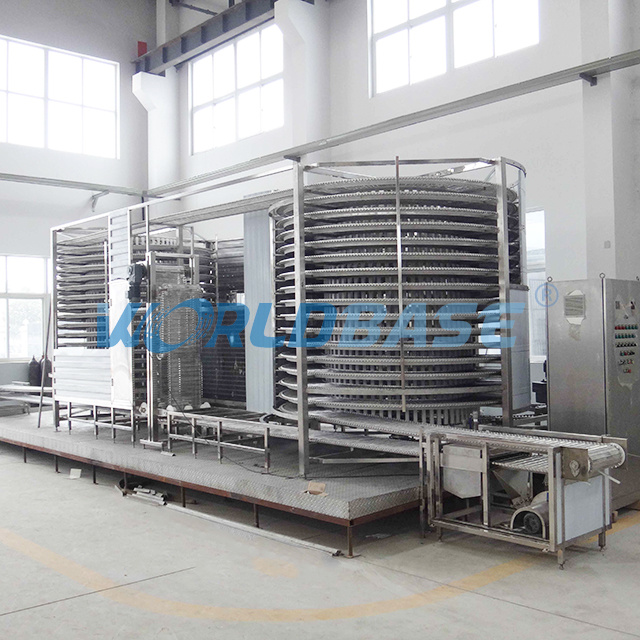
Space is a premium in any food processing facility, and spiral freezers address this challenge by using a vertical stacking design that turns upward instead of outward. The continuous belt coils into compact tiers, effectively multiplying the freezing surface area within a footprint that a linear tunnel would quickly outgrow. This approach allows processors to maintain high throughput without needing sprawling single-level layouts, making it an ideal solution for plants where square footage is tightly constrained.
The engineering behind these systems eliminates the usual trade-off between capacity and compactness. By carefully controlling belt speed, stacking height, and airflow through the coiled structure, spiral freezers achieve uniform freezing across all product layers. Even with tight floor dimensions, the multi-tier configuration packs extensive belt length into the same ground area, so production volume per square meter often sees a substantial increase compared to conventional blast freezers.
Maintenance and sanitation also benefit from the upright structure. Many modern spirals include self-stacking belts and direct access to critical components without requiring extensive clearance around the machine. As a result, the space saved isn't just about installation footprint—it also simplifies workflow, reduces building costs, and keeps the processing line open for other equipment, giving operators far more flexibility in layout design.
Preserving texture and taste through uniform cold air distribution
When you open the fridge and grab that leftover pasta, you expect it to taste just as good as the night before. But too often, cold spots and inconsistent airflow turn your meal into a patchwork of dry edges and limp centers. The secret to keeping every bite intact lies in how well the cold air moves around your food, not just how low the temperature goes.
Uniform cold air distribution eliminates the harsh blasts that can freeze the surface of delicate items while leaving the core lukewarm. By circulating chilled air gently and evenly, each ingredient stays at its ideal state—crisp vegetables retain their snap, creamy sauces don’t separate, and meats avoid that dreaded freezer burn. It’s a delicate dance of thermodynamics that mimics the steady cool of a natural cellar.
The difference is something you can taste. Fresh basil stays fragrant, cheese doesn’t sweat, and even a simple bowl of strawberries keeps its firm, juicy character for days longer. This even cooling doesn’t just prolong shelf life; it safeguards the texture and flavor that make food enjoyable, turning your refrigerator into a preservation tool rather than a cold box of compromise.
Energy recovery innovations that slash long-term operating costs
When factories harness waste heat that once vanished into the air, they tap into a quiet revolution that reshapes the bottom line. Instead of letting exhaust streams escape at hundreds of degrees, modern recovery systems route them through heat exchangers or organic Rankine cycle units, converting thermal leftovers into electricity or preheated feedwater. This isn't just trimming the utility bill—it's turning a liability into a round-the-clock asset that quietly chips away at operating expenses year after year.
Beyond the obvious capture of heat, today's smart recovery setups lean on adaptive controls and compact designs that slide into existing footprints without massive retrofits. They adjust in real time to process swings, maintaining efficiency even when production ramps up or down. The result is more than energy savings; it's a reduction in cooling tower load, less strain on boilers, and often a quicker payback than forecasted because the systems run unattended, leveraging waste that would otherwise cost money to reject.
What makes these innovations truly stick is their synergy with day-to-day operations. A well-integrated recovery loop can stabilize process temperatures, improve product consistency, and extend equipment life by smoothing out thermal cycling. Maintenance teams notice fewer hot spots and less scaling, while finance sees the cumulative effect of lower fuel purchases and carbon-related expenses. In the long run, it's this holistic trim—spanning energy, maintenance, and compliance—that keeps the operating budget lean without shouting for attention.
Adapting spiral systems for delicate products like ready meals and seafood
Handling ready meals and seafood on a spiral system isn’t just about moving things up or down—it’s a careful dance. These products bruise easily, shift in their packaging, or get misshapen under too much pressure. Standard conveyors often treat everything like a box of cereal, but a piece of fresh salmon or a microwavable pasta bowl doesn’t forgive that approach. The real trick lies in tuning the system to cradle rather than toss, so each item arrives looking exactly as it should.
One of the first things we tweaked was the belt itself. Switching to a softer, grip-friendly surface with gentle dimples helped keep trays and fillets from sliding into each other on inclines. We also slowed the transfer points just enough, adding minute pauses that let the product settle before the next leg. For seafood, especially, the freezing tunnel zone got a redesign, with airflow dampeners so icy blasts wouldn’t batter the delicate flesh. Even the drum diameter matters; a wider spiral curve reduces the twist stress on anything that’s not rigid.
The payoff isn’t just fewer rejects—it’s in the silent approval of a chef who doesn’t have to replate a wrecked dish. By listening to how each product behaves on a pilot run, we dial in settings that stick. A seafood plant cutting its downgrade rate by a third or a ready-meal line finally running at full speed without smeared sauces proves the effort’s worth. It’s not a one-size-fits-all game; it’s about letting the product teach the machine what gentle really means.
What to look for when partnering with a spiral freezer manufacturer
A reliable partner starts with proven engineering depth. Look beyond glossy brochures and ask how they handle extreme thermal cycling, belt tension variance, and sanitation challenges specific to your product line. The manufacturer should openly discuss airflow distribution methods and demonstrate an understanding of freeze time consistency across the belt width, not just overall throughput.
After-sales support can make or break your production uptime. Evaluate whether they offer on-site technical training for your team, how they manage emergency spare parts in your region, and whether their service technicians truly understand the integration points with upstream and downstream equipment. A manufacturer that provides remote monitoring and predictive maintenance insights helps you avoid unplanned downtime rather than just reacting to it.
Customization and testing capabilities separate commodity suppliers from true collaborators. Insist on seeing their test lab and processing your actual product under conditions that mirror your production environment. The best partners will challenge your assumptions about dwell time, belt material, or air impingement design, offering tangible data from prototyping sessions that directly translate to your floor plan and utility constraints.
FAQ
Spiral freezers stand out because they combine high throughput with a small footprint. Instead of spreading out horizontally, the conveyor belt coils upward in a helical stack, so a facility can freeze large volumes without sacrificing valuable floor space. This design also allows consistent airflow around each product, leading to faster, more uniform freezing and better preservation of texture and taste.
Several names dominate the field. GEA and JBT are known for robust, customizable systems that handle everything from baked goods to proteins. Linde and Air Liquide bring cryogenic expertise, integrating liquid nitrogen or CO₂ for rapid chilling. Smaller specialists like Dantech and FPS offer highly modular units that appeal to mid-sized processors looking for flexibility without massive capital outlay.
Modern spiral freezers now use variable-speed fans and intelligent defrost cycles that cut power consumption by up to 30% compared to older models. Designs with low-volume ammonia charges and improved insulation also reduce heat infiltration. Some companies install heat recovery systems that repurpose waste heat for cleaning or plant heating, turning a cost center into a resource.
Products that need individual quick freezing (IQF) are ideal candidates—think shrimp, diced poultry, berries, and pizza toppings. Strudels, pastries, and ready meals also do well because the gentle, controlled cold air preserves shape and crust integrity. Essentially, anything that requires a short retention time and careful handling suits spiral systems.
Floor space is a major capital expense in food plants. A spiral freezer packs impressive capacity into a vertical cylinder, often using a quarter of the area that a tunnel freezer would need for the same output. This frees up room for other processes, simplifies layout planning, and can reduce construction and refrigeration infrastructure costs.
Advanced airflow management is a big one—dual-zone or even tri-zone systems let operators fine-tune temperature and velocity at different belt levels. Self-stacking belts and hygienic open-frame construction make cleaning faster and more thorough, reducing contamination risk. Some providers now integrate real-time thermal imaging to adjust conditions automatically, ensuring every piece exits at the exact target core temperature.
Blast freezers typically freeze products in batches on stationary racks, which can lead to uneven results and longer cycle times. Spiral freezers operate continuously, moving product on a conveyor, so the process is steady and more uniform. While blast freezers are less expensive for very small-scale or infrequent use, spirals offer far better efficiency, throughput, and consistency for mid- to high-volume operations.
Look beyond the initial price and focus on sanitation features, such as fully-welded floors, sloped surfaces, and easy belt removal. Examine the supplier’s engineering support for airflow customization and hygienic design standards like AMI or EHEDG compliance. After-sales service, spare parts availability, and the ability to upgrade or expand capacity later often matter more in the long run than a low upfront bid.
Conclusion
Spiral freezer companies have redefined industrial freezing by engineering systems that combine speed, consistency, and remarkable space economy. Unlike traditional blast or tunnel freezers, these units leverage a helical conveyor design that continuously moves products through a controlled cold air stream. This achieves rapid heat transfer without the temperature shock that damages cell structures in food. The result is a faster freeze that locks in moisture, preserving the original texture and flavor far better than older methods that often leave items dehydrated or unevenly frozen. Compact vertical architecture is another breakthrough: by stacking the freezing path upward, a spiral freezer can process the same volume as a linear line while occupying a fraction of the floor space, freeing up valuable production areas for other operations.
Leading manufacturers have pushed efficiency further with energy recovery systems that capture waste heat from compressors to pre-heat defrost cycles or warm facility areas, cutting utility bills significantly over time. They also excel at tailoring systems for fragile goods—think sauced pasta, whole fish fillets, or bakery items—where gentle handling and precise airflow prevent clumping and breakage. When evaluating potential partners, look beyond basic specifications: assess their track record with similar product types, ability to customize belt materials and cleaning protocols, and long-term support for upgrades. The best suppliers treat the freezer as a core processing asset, not just a commodity, helping processors adapt to evolving market demands without replacing entire lines.
Contact Us
Contact Person: Mr Yang
Email: [email protected]
Tel/WhatsApp: +8613809083091
Website: https://en.worldbase.cn