

Wholesale MVNE Platform Essentials for Launching a Competitive Mobile Brand
2026-09-06
The mobile landscape is crowded, yet every day new brands manage to break through. What separates those that thrive from those that barely launch? Often, it’s the invisible backbone: a wholesale MVNE platform built for speed, scale, and differentiation. Whether you’re planning a niche IoT play or a full consumer push, the essentials you choose now decide how fast you go to market and how much margin you keep. And when that backbone comes from IPLOOK, you’re not just renting infrastructure—you’re tapping into a partner that treats your brand’s launch as its own. In this post, we’ll strip away the jargon and lay out the exact building blocks you need to launch a mobile brand that doesn’t just compete, but commands attention from day one.
What an MVNE Actually Does for Your Launch (and What It Won't)
An MVNE hands you the plumbing that makes your mobile brand possible without forcing you to rebuild the entire network stack. Think of it as leasing a fully equipped kitchen rather than constructing a restaurant from the ground up. You get access to core network elements, billing systems, SIM provisioning, and often wholesale airtime agreements—pieces that would otherwise take years and deep capital to assemble. This lets you focus on the parts that actually differentiate you: your brand voice, your customer segments, your device bundles, and your go-to-market story. Without an MVNE, you'd be spending your first eighteen months negotiating roaming deals and debugging OCS interfaces instead of signing up your first thousand subscribers.
What an MVNE won't do is build your brand, design your pricing tiers, or handle your customer support for you. It provides the rails, not the train. You still own the subscriber relationship, the marketing spend, the churn risk, and the day-to-day operations. Some founders mistake the MVNE's platform for a turnkey business-in-a-box, only to discover that the real work—acquiring users profitably, managing device logistics, and answering billing disputes—remains entirely on their plate. The MVNE's value is in removing the heavy technical and commercial integration burden, not in replacing your need for a real operator mindset.
A practical way to think about it: the MVNE shrinks your time-to-launch from twenty-four months down to maybe six, and it converts massive fixed costs into variable per-subscriber fees. That's a genuine launch accelerator. But it also means your unit economics are tightly coupled to the MVNE's pricing and your own operational discipline. If you can't control acquisition costs or support overhead, the MVNE's efficiency won't save you. Use it as the foundation, then bring your own differentiation—a sharp niche, a better onboarding flow, or a smarter device strategy—because that's the part no enabler can hand you.
Picking a Core Network That Won't Crumble at 100K SIMs
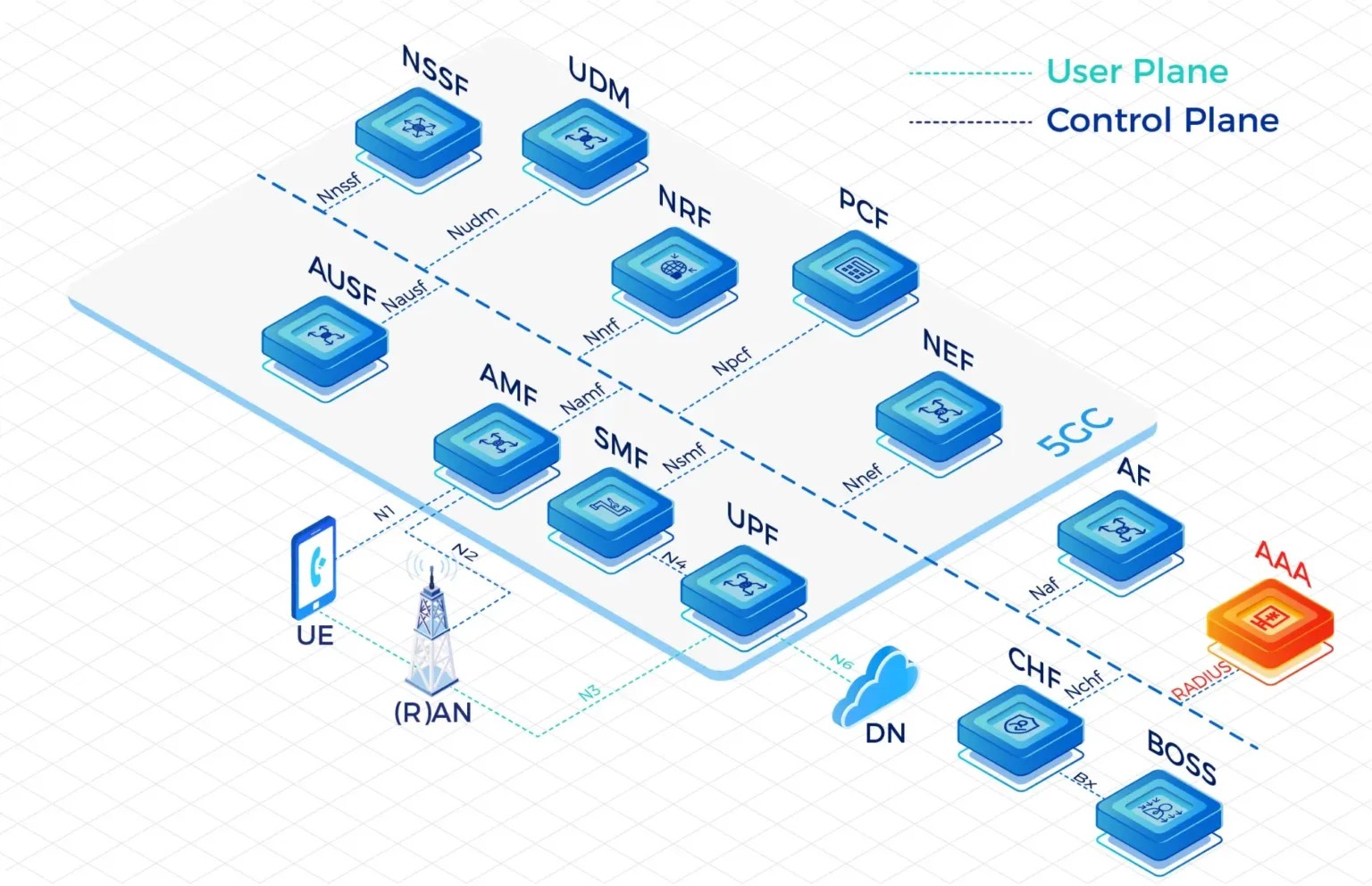
At 100K SIMs, the core stops being a lab toy and starts behaving like a small carrier. What breaks first is rarely the data plane. It's the control plane: a fleet of devices all trying to attach after a power outage, an update push that triggers simultaneous re-registrations, or a misconfigured APN causing endless retries. A core built on a single monolithic HSS/HLR or a homegrown diameter stack will fold under that burst long before throughput becomes an issue. The test isn't steady-state throughput; it's how many attaches per second the stack can absorb while still processing existing sessions.
Look for a core that separates the home subscriber database from the gateway functions and can scale them independently. At this size, you want stateless front-end nodes backed by a distributed database, not a box that keeps subscriber state in local memory. Ask vendors how they handle a re-registration storm: do they queue, drop, or shed load gracefully? If the answer is "we've never seen that" or "our hardware is fast enough," walk away. The difference between 20K and 100K SIMs is not just more licenses; it's the point where lazy database lookups and synchronous replication turn into cascading latency.
Also watch for hidden coupling in the packet core. Some cores claim horizontal scaling but still funnel all GTP-C traffic through one control node or share a single stateful load balancer. That becomes a silent bottleneck at peak registration events. A better architecture lets you add control-plane instances without re-architecting, uses asynchronous replication between sites for subscriber data, and actively tests failure modes like losing a diameter peer mid-call. If the vendor can't show you a test report for 200 attaches per second with 100K provisioned SIMs and real device behavior—not synthetic traffic—you're betting the network on a promise.
Billing and Charging: The Silent Killer of Mobile Margins
The billing stack rarely gets attention until something breaks, but every month it quietly shaves a few basis points off margins. For operators running multiple legacy systems stitched together after mergers or new service launches, the real cost isn't the license fee—it's the slow bleed from mispriced plans, uncollected overage charges, and transaction fees that never get reconciled.
A single misconfigured rating rule can go unnoticed for quarters, while finance teams wonder why ARPU is drifting downward. When billing errors surface, they often trigger refunds, support calls, and churn that no marketing campaign can offset. The worst part: most operators measure network cost per gigabyte down to the cent, yet have no equivalent visibility into cost per invoice or revenue leakage per tariff.
Fixing this doesn't require ripping out the entire stack. A practical audit of tariff configurations, mediation logs, and settlement reports usually uncovers enough leakage to pay for itself within a year. The operators that treat billing as a margin lever, not just a back-office necessity, are the ones holding onto profitability while competitors race to the bottom on price.
Customizing Your Brand When You Don't Own the Radio Access
Operating as a virtual network provider means you never touch the base stations, spectrum licenses, or core switching hardware. That lack of physical control often gets framed as a limitation, but it can actually sharpen your focus on the layers where customers form real opinions. Instead of chasing signal bars you cannot change, you pour energy into billing clarity, support responsiveness, and plan structures that feel personally fitted. Customers rarely remember network uptime statistics; they remember whether an agent solved their issue in one message or whether an unexpected charge showed up without explanation.
The brand then lives in the details of interaction design. You can build an onboarding flow that speaks like a helpful friend rather than a telecom manual, offer usage alerts written in plain language, and create account dashboards that surface only what matters to each subscriber. Even the tone of your error messages becomes a branding asset. When a service interruption occurs—and it will, because you rely on someone else’s infrastructure—your response can turn frustration into loyalty by being honest about the cause, offering a concrete credit, and following up the next day. That kind of proactive care is rare and far more memorable than a logo.
Over time, your brand becomes synonymous with respect for the customer’s time and intelligence. You don’t compete on network coverage maps you don’t own; you compete on the quality of every touchpoint after the SIM card activates. Some providers have built cult followings purely through quirky invoice notes or a no-hold phone line. The secret is refusing to hide behind the wholesale agreement. When something goes wrong, you say so, fix it fast, and treat the next interaction as a chance to prove the relationship matters more than the radio access you borrowed.
Launch Speed vs. Long-Term Flexibility: The Real Trade-Off
Every product team dreams of shipping fast, but speed without architectural headroom eventually feels like sprinting through wet concrete. The first few releases come easy because the codebase is still small and the domain is fuzzy enough to tolerate shortcuts. Then the edge cases pile up: a feature that should have been a configuration flag becomes a hard-coded branch, a data model that worked for five users now groans under five thousand, and the promise of “we’ll refactor later” keeps sliding past every deadline.
Flexibility, on the other hand, asks you to invest before the payoff is visible. Abstracting too early can paralyze a launch—you spend weeks building a plugin system nobody asked for while competitors ship a simpler version and capture the market. The real trade-off is not between bad and good engineering; it’s between the cost of delay today and the cost of change tomorrow. The trick is to recognize which parts of the system are likely to evolve and which are stable enough to leave alone.
A useful rule of thumb is to make reversible decisions quickly and irreversible ones slowly. If a data schema can be migrated later without much pain, don’t overthink it. If an API contract will be exposed to external partners, spend the extra week making it forgiving. Speed and flexibility are not enemies when you treat them as different currencies: spend speed on experiments that can fail cheaply, and spend flexibility on foundations that would be expensive to rebuild.
Compliance Layers That Keep Regulators Off Your Back
Most companies treat compliance like a checklist. The ones that stay out of trouble build it in layers. Identity and access controls sit at the center, deciding who can touch what. Around that, encryption and data masking keep sensitive information unreadable to anyone without a need. Further out, automated audit logs record every action without relying on someone remembering to save a file.
The layer that actually keeps regulators away is the one that catches drift before it becomes a finding. Real-time policy enforcement stops a misconfigured bucket or an over-permissioned role the moment it happens, not during a quarterly review. When a control fails, the system quarantines the issue and opens a ticket with the evidence already attached. That turns a potential violation into a documented, resolved event.
Regulators don't just want to hear that you're compliant; they want to see the trail. That's why the outermost layer is a reporting fabric that pulls from every control point into one immutable timeline. When an audit request lands, you export the relevant slice instead of scrambling across spreadsheets. It doesn't make compliance exciting, but it does make it boring in exactly the way you want—boring enough that no one asks for a follow-up meeting.
FAQ
A wholesale MVNE supplies the heavy infrastructure layer most startups cannot afford to develop in-house: core network access, billing and provisioning systems, SIM management, and regulatory compliance support. Instead of spending years integrating with mobile network operators, a brand plugs into an existing platform and focuses on its market entry.
Because the MVNE already holds commercial agreements and technical integrations with one or more host networks, a new brand skips lengthy negotiations and interoperability testing. A launch that might take eighteen months from scratch can often be compressed to a few months, sometimes even weeks.
Real-time rating and charging, flexible plan configuration, automated SIM activation, and open APIs are non-negotiables. Without these, the brand will struggle to iterate pricing, onboard customers smoothly, or connect its own customer-facing apps.
Differentiation has to come from the brand layer: target audience, bundle design, support quality, and unique digital experiences. The underlying network may be shared, but the way a brand packages data, roaming, and loyalty perks is what wins customers.
Real-time billing lets a brand offer pay-as-you-go data add-ons, instant top-ups, and hard spending caps without bill shock. If billing is batch-based or delayed, the brand cannot support modern prepaid or hybrid models that many value-focused users expect.
The MVNE typically inherits coverage from its host mobile network operator, so the brand must examine actual coverage maps and service level agreements, not just marketing claims. Some MVNEs can aggregate multiple networks or offer seamless roaming, which becomes a strong selling point for travelers or rural users.
Number allocation, lawful intercept, emergency calling, data retention, and number portability are usually handled by the MVNE's existing legal and technical frameworks. This removes a huge administrative load and reduces the risk of launching in a new market with missing compliance pieces.
Look for multi-tenant architecture, API-first design, elastic cloud resources, and a track record of supporting brands from a few thousand to millions of subscribers. A platform that cannot seamlessly upgrade from light MVNO to full MVNO status will eventually force a costly migration.
Conclusion
Launching a competitive mobile brand on a wholesale MVNE platform means understanding exactly where the MVNE adds leverage and where you still carry the weight. An MVNE handles the heavy technical integration—core network access, SIM provisioning, and back-end systems—but it won't build your brand identity, manage your customer support, or magically fix a poor go-to-market strategy. The real value shows up in two places: picking a core network that handles 100,000 SIMs without latency spikes or dropped sessions, and deploying a billing and charging engine that doesn't quietly eat your margins through rigid rating rules or delayed revenue recognition. Many new brands overlook billing as a back-office chore, yet it's the silent killer—inflexible plans, slow invoicing, or poor real-time balance checks will drive churn faster than a weak network. Meanwhile, customizing your brand without owning the radio access means you're limited to what the MVNE's APIs and white-label portal allow, so choose a partner with deep configuration options rather than a one-size-fits-all UI.
The second cluster of essentials revolves around speed versus flexibility and regulatory hygiene. A wholesale MVNE can get you to market in weeks, but that speed often comes from pre-built templates that later resist deep changes to pricing, bundles, or user journeys. Ask hard questions about whether the platform supports headless commerce, event-based charging, and custom workflow hooks before you sign—otherwise a fast launch becomes a long-term straitjacket. On the compliance side, layers like lawful intercept, data retention, KYC/KYB checks, and number portability aren't optional extras; they're the difference between a stable operation and a regulator's audit nightmare. The best MVNE platforms bake these compliance layers into the core stack with automated reporting and audit trails, so your team isn't manually patching together spreadsheets each quarter. Ultimately, launching a competitive mobile brand on a wholesale MVNE is less about the radio access you don't own and more about the operational discipline you bring to billing, core network selection, brand customization boundaries, and regulatory readiness—all while keeping an eye on the real trade-off between launch speed and long-term flexibility.
Contact Us
Contact Person: Shimmy
Email: [email protected]
Tel/WhatsApp: 85253392231
Website: https://www.iplook.com